Showing posts with label healthy rhythms. Show all posts

Saturday, December 7, 2013

The Gift of Solitude: applicable to all adults, as described in a young adult novel.

If there is one thing I try to share with my students throughout the year, it's the idea that each one of them has a story: that you can never know someone's story just by looking at them, that it is one of life's greatest gifts to get to hear other people's stories, and that it is a privilege for me to get to know theirs throughout the course of the year.  My hope is that they will take the time to really know one another and build a community of understanding, respect, and kindness.  

And then I had a moment where I met a protagonist I wanted every student to know:

If there's one thing I've learned, it's this: We all want everything to be okay (page 6).

The only way I can navigate through my life is because of the 98 percent that every life has in common (page 77).

In my experience, desire is desire, love is love.  I have never fallen in love with a gender. I have fallen for individuals.  I know this is hard for people to do, but I don't understand why it's so hard, when it's so obvious (page 142).

A handful of my students were raving about Everyday by David Levithan in our weekly "Friday Favorites" five minute share and after hearing the premise, I knew I wanted to check it out.  The protagonist, A, is essentially a soul (without a gender): s/he wakes up in a new body everyday while maintaining a fully developed sense of self--just no physical body with which to express him/herself.  This is one of the most thought provoking and creative young adult books I've ever read.  It touches on so many young adult emotional-development issues, but not in a preachy way: the protagonist authentically brings them up and because his/her life experience is so different than the average human, and based on what I've witnessed in my classroom, I think young adult readers will just soak it in.  

But I also found a section that spoke into everything I've been thinking about lately: maintaining a sense of self, of peace, of purpose.  He falls for the girlfriend of a [horrid] guy whose body he occupies for a day and then ends up maintaining a relationship with her--his/her first ever--though each day s/he is in a new body. S/he sees the stress she deals with and the broken, hurtful relationship she is in.  When s/he unexpectedly wakes up in her body one day, he decides to try to give her the gift of peace in solitude and goes for a long hike.  The description he uses is amazing: 

I've decided to give Rhiannon the satisfaction of being fully alone.  Not the lethargy of lying on the couch or the dull monotony of drifting off in math class.  Not the midnight wandering in a sleeping house or the pain of being left in a room after the door has been slameed shut.  This alone is not a variation of any of those.  This alone is its own being.  Feeling the body, but not using it to sidetrack the mind.  Moving with purpose, but not in a rush. Conversing not with the person next to you, but with all of the elements.  Sweating and aching and climbing and making sure not to fall, not to get too lost, but lost enough...When no one else is around, we open ourselves to the quieter astonishments that enormity can offer (197-198).

I meet monthly with some friends and we talk about the creative pursuits in our lives and what we are learning about ourselves in the process.  It has become a treasured time for me.  My November wasn't as creative as I planned: I made some substitutions for painting and calligraphy in the name of stress and exhaustion and travel, which at the time seemed justifiable.  I realized, though, that my substitutions weren't the same, even though I was technically "doing nothing." I realized once again that I need to spend intentional time opening myself "to the quieter astonishments that enormity can offer"--whether that enormity is staring at sky behind the branches of newly leafless trees, breathing in the scent of my Christmas tree, or taking out my paints and ink to let go and create.

Here's to a beautiful winter season filled with beauty amidst the darkness.

(And here are some other winter thoughts in case you, too, struggle with the fact the sun goes down at 4:30, or just need some context and/or hope from someone who is often winter-hopeless).

Saturday, November 2, 2013

Brene Brown, game changer.

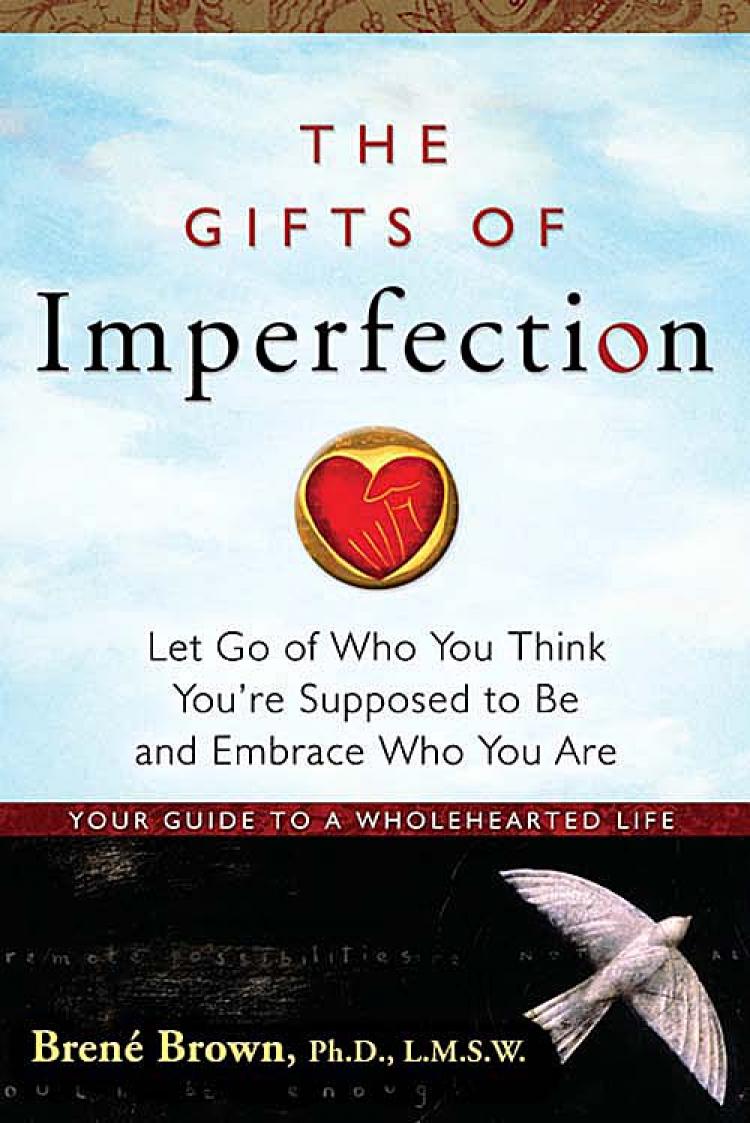
I first heard of Brene Brown last winter when my friend Lindsay told me I had to watch her TED talk called "The Power of Vulnerability." It was a game changer for my emotional health, y'all.  Then Lindsay and I decided we would both read her book The Gifts of Imperfection and it was the perfect follow up for helping me process through what it means to live with meaning and purpose and without anxiety.  Reading the book and reflecting on Brown's research and how it related to my life has been an incredibly powerful experience.  I've slowly and reflectively read this book over the past five months or so. This post is a little vulnerable, but I think Brene Brown would be in favor of me sharing and owning these pieces of my story.

My core spiritual beliefs (grace, love, forgiveness, stillness) have remained much the same over the years, but there came a time when I had to face the fact that from every angle I was hearing: strong people of faith ________.  As a high achieving people pleaser, for many years I ran without stopping in my volunteer work, my actual work, and in the commitments I made in my free time.  Sometimes despite hearing an overarching message of grace and love, I felt as though I was constantly not measuring up to what I was "supposed" to be doing, which was difficult for a perfectionist (though now I consider myself a recovering one) and felt as though I had to be apologetic for my introverted nature.  I've taken the past few years to redefine what a spiritual life looks like for me and to (finally) learn to be ok with the fact that it does need to look like anyone else's.

A lot of authors have mentored me through this journey: Mother Theresa with Come Be My Light, Anne Lamott with Traveling Mercies and Bird by Bird, Joan Didion with The Year of Magical Thinking, Susan Cain with Quiet, Colum McCann with Let the Great World Spin, Eric Metaxes with Bonhoeffer, and of course the poetry and music of Over the Rhine.  What I appreciate about Brene Brown is that her book seemed to pull together all of these literary influences and helped me to redefine and find freedom in what spirituality looks like for me.


In the journey of trying to define what my spiritual life looks like now, it honestly can be easy to simply not think about it, thus avoiding existential dilemmas.  But, the anxiety that so easily creeps in reminded me that being grounded and intentional is life giving and I noticed that not having an intentional grounding in faith, I became less hopeful in general, a bit cranky, and I forgot to look for beauty.  Brown's definition of spirituality piqued my interest because I was (still am) so tired of the minutia of Christian theology:  "By spirituality, I'm not talking about religion or theology, but I am talking about a shared and deeply held belief.  Here's how I define spirituality: Spirituality is recognizing and celebrating that we are all inextricably connected to each other by a power greater than all of us, and that our connection to that power and to one another is grounded in compassion.  Practicing spirituality brings a sense of perspective, meaning, and purpose to our lives" (64).  


When she wrote "It's not about denominations or dogma. Practicing spirituality is what brings healing and creates resilience. For me, spirituality is about connecting with God, and I do that most often through nature, community, and music.  We all have to define spirituality in a way that inspires us,"(74)  I was reminded of the life nature gives me and how washing dishes or walking with music centers me, and how dinner with my husband and great friends grounds and connects me.

One of the messages I have struggled with as a Christian is that "everything happens for a reason," which I simply cannot buy into no matter how many scripture based conversations I have.  This felt really isolating, especially in the early days of this journey.  I have landed in a place of confidence and rest with this issue and others, and reading Brown's book helped give greater clarity to me: "At first I thought faith meant 'there's a reason for everything.'  I personally struggled with that because I'm not comfortable with using God or faith or spirituality to explain tragedy...Here's how I define faith based on research interviews: Faith is a place of mystery, where we find the courage to believe in what we cannot see and the strength to let go of our fear of certainty" (90).  Faith as a beautiful mystery has been one of the most healing perspectives I've run across.  

To close, one of my favorite parts of the book was when Brown discussed the fact that we can change our neurological pathways, something one of my old pastors used to talk about, too.  It is possible to physiologically change our patterns of thinking (google neuroplasticity).  I'm now living in a way where I am trying to incorporate rhythms into my life that help me feel grounded, connected, grateful, and covered in grace.  This is happening for me through reading, taking time to be creative (watercolor and calligraphy lately), cooking, looking for beauty, and  practicing stillness.  It looks different, but feels beautiful.  

Sunday, October 6, 2013

The Age of Miracles & maintaining a sense of self


Months ago I saw the book The Age of Miracles by Karen Thompson Walkder and added it to books I wanted to read, namely because it sounded like a good next step for my 8th graders who had read every futuristic, dystopian novel in the young adult section and were ready for an adult level book.  I ran into it the while browsing in the digital books collection of the Brooklyn Public Library and decided it should be my first library ebook.

The premise of the story is that one seemingly typical morning, people wake up to a news story that states the rotation of the earth has shifted and minutes have been added onto the day.  This continues and throws the entire world into a frenzy as the governments decide to remain on 24 hour clock-time which, as the days grow longer, can mean the waking "day" is completely in the dark and the sun is shining brightly while people are sleeping at "night."  Of course there are people who decide to rebel and let their circadian rhythms readjust, but soon the days become 48 hours long.  Some people become afflicted with sickness, tides are shifted way off and coasts flood, the magnetic field is damaged and the sun's rays become so dangerous that people do not walk into the sun anymore.

What I kept thinking about was that even though there were life changing and life threatening conflicts, people needed to maintain a sense of self in the face of it all--and that may be what enables them to face the conflicts with courage. This made me start thinking about when everything in life feels like it is being thrown off--when the earth's rotation in this story is like a metaphor for our lives--how do we cope? 

I've been thinking a lot lately about the importance of taking the time to do the things that are good for my soul--even if that means not finishing everything on my to do list.  Or even if it means deciding to paint or bake instead of sitting in front of another crime show--which feels relaxing for the moment, but doesn't impact my sense of well being in the long run. 

What was devastating in the book was when the government decided to make a time capsule of sorts so that if civilization were destroyed, people of the future would have an understanding of the age.  Inside the capsule, though, was a disc that contained information about how civilization worked: the internet, government systems, medical advances.  Our narrator, who is telling the story from her mid twenties about her 12 year old self said: "Not mentioned on the disc was the smell of cut grass in high summer, the taste of oranges on our lips, the way sand felt beneath our bare feet, or our definitions of love and friendship, our worries and our dreams, our mercies and our kindnesses and our lies," (267).  These are the things of actual life.  The things that she shares throughout the length of the book itself.  And that, is a beautiful and clever idea from the author: it is the stuff of stories that make life worth living.  (It reminded me a lot of this book, which I also wrote about here.)

And so, I've tried to be in pursuit of these things that remind me of the goodness of life; the things that store up strength for later and can provide true comfort.  For me, that has meant art and cooking real meals and going for runs in Prospect Park to soak in the season.  Having these rhythms in place keeps me grounded when life seems to throw everything else off.  And that in and of itself, constitutes a miracle.  

Sunday, September 15, 2013

Feeling September-ish. Or, how Over the Rhine reinvigorated my life last weekend.

This post switched directions a number of times as I wrote it this morning.  There are just a lot of big ideas swirling in my brain this week about music and art and words.  The short version is that music and lyrics breathe life into us.  If you want to take the long way around, read on.

Perfection, to me, often involves traveling with the right kind of music.  In college, I drove on State Route 73 in southwest Ohio at least three times a week.  Most of the time it was early evening when the light softens or at night--and out there you can see so many stars because Oxford, Ohio is surrounded by farmland.  Since I was in Oxford from September-May, these drives often were accompanied by open windows and the heat on my feet.  And of course, the right kind of playlist.  My car became a sanctuary of sorts that allowed me to have time and space to think by myself and my music--the 5 inch binder of CD options--was what spoke to me.  I'm realizing looking back just how important those moments of listening to music and lyrics was to my mental and emotional health.  Those were the days when music like Over The Rhine and Ryan Adams and Patty Griffin were brand new to me.  I heard Bela Fleck's Big Country for the first time.  The Dixie Chicks threw some attitude into my country music and Nickel Creek pulled me into bluegrass.

Since moving to New York ten years ago, my rhythms with music have changed considerably, mostly because one can't take the subway and look out on farmland at the same time.  Ten falls ago I walked with my tea to the Hudson River at Riverside Park seeking healing from homesickness and took the music that felt like home, namely the OTR's Ohio album.  When I moved downtown my river walks and runs changed me along with Iron and Wine and Sufjan Stevens and of course Drunkard's Prayer.  When I moved to Brooklyn, I commuted by foot and rotated The Head and the Heart, Fleet Foxes, Alicia Keys, Miranda Lambert through the streets of my neighborhood, along with a heavy dose of The Long Surrender.

Last March I moved out of the apartment I lived in by myself into one a stone's throw from work. It took me five months to realize that music wasn't playing in the way it once was.  Luckily, this realization came right before a new school year started, and therefore is helping to set the tone for this new season of my life.  September is essentially my new years, after all.  I was lucky enough to escape to Cape Cod during the four days before school started and poetically, Over the Rhine just released their latest album. I knew that to appreciate it fully I needed to hear it not just while doing dishes in my apartment, but away from the city.  I had just read an article about their writing process and learned that my life-line song on their last album was inspired by one of my favorite poets, Adam Zagajewski.  I also read how one of the new songs was inspired by Anne Lamott.  It all seemed too perfect a way to start a new year of teaching reading and writing--and to be reflective and writerly along the way.


So, I was with kindred music listeners.   We put it on as soon as we got past anything that felt like city life, and my ability to breathe deeply coincided with Karin Berquist's voice and Linford Detweiler's piano and the rapid increase in trees outside my window.  That was when I was reminded of driving on 73 in my home state--where the music and the lyrics hit you right where they need to and your lungs can fill with air again.

So all weekend, on near empty beaches, with coffee and Bailey's, and in a hooded sweatshirt I listened to Meet Me At the Edge of the World and felt whole and at home.

Saturday, May 25, 2013

Rhythms and Anchors: life truth from young adult literature


I've been reading up a storm lately, but you couldn't tell by looking here.   I recently finished Tell the Wolves I'm Home by Carol Rivka Brunt and reread Crank by Ellen Hopkins with my students.  I  also reread the young adult Tales of the Madman Underground by John Barnes for my graduate class and loved it just as much the second time around.  It is set in a small Ohio town in 1973 and the Karl, the high school senior protagonist has been a part of a therapy group at school since elementary school.  They dubbed themselves the Madman Underground, since they know everything about each other's lives, but generally stick to their own social circles outside of therapy.  Karl's dad passed away and his cat-hoarding mother drinks her nights away and steals Karl's money to pay for it.

This calendar year has felt like a whirlwind to me: planning a wedding, moving to a new (fixer upper) apartment, and going back to graduate school on top of grading essays and state tests has left me feeling scattered and in survival mode--I've spent quite a bit of my walking time getting from one place to the next dreaming about getting upstate with some English breakfast tea, hiking boots and a pile of books.  In the midst of the crazy, I came across this passage from Madman from a scene when Karl feels exhausted and overwhelmed and looks over to a list of household projects and chores that his dad made for him before he died:


Dad had left me a list, month by month and week by week, when to do all the stuff he'd shown me how to do.  I couldn't always keep up with it, between Mom and the cats. I knew it would all fall to shit the minute I left for the army.  Still, mostly I kept it up.  Nights when I couldn't sleep, I'd just turn on my desk lamp, point it at the wall, and read that list to myself til I knew where I was in the world again (110).

I actually teared up thinking about Karl re-grounding himself in rhythms that were passed down to him by his father and the way that rereading them enabled him to remember his true identity.  This is the piece that I have often gone without this year--I have kept going and going and the easiest things to let go of were the rhythms and anchors that remind me of who I am--be it through writing, running in the park, cooking a meal.  We are also in the midst of our final unit: studying Coming-of-Age literature and thinking about what it means to grow up, and this wisdom from Karl is some of the best advice I could ever give a teenager, and also helps put their lives and craziness into perspective.

There was a crazy day last week when I didn't have time to cook but couldn't bear to order in food that wouldn't feel good to my body.  So I decided to make a meal that would take the longest to make, of course: risotto with spring vegetables.  I was filled with anxiety and my mind was looming with deadlines, but decided that it was worth it to walk to a grocery store much further than the two closest to me to get higher quality vegetables.  Within a block of walking I was so taken by the late spring evening light and my neighborhood's energy that I was able to completely reset my mindset.  It was a mental miracle.  


So.  I realized that I needed to build in some time for anchoring myself just like Karl did.  This week I started reading Brene Brown's The Gift of Imperfection with a friend of mine (after seeing her game changing Ted Talks last fall and being blown away).  One of the first things she talks about is recognizing the moments when you feel yourself becoming depleted and to do something about it in the moment--remembering your anchors and truths.  This past week I've been able to climb out of the craziness bit by bit and breathe.

It also helps that summer is so close.