Showing posts with label teaching. Show all posts

Sunday, September 1, 2013

Reflections on my first month of E-Reading

If you were to walk into my apartment, you would find three industrial sized shelves filled with books that we were certain would be ample space for a growing library, but were filled to the brim by the time we were done unpacking.  My piles of books have grown to the coffee table, living room floor, and of course my nightstand.  I'm old fashioned in that not only do I love the smell of paper books, old and new, I also think that stacks of beloved books are one of the best ways to decorate a home.  My old studio apartment didn't have room for shelves, so they were stacked into piles all around the periphery and somehow that worked, too.

So you'd understand how strange it was as I got more involved in education conversations about technology in the classroom and the tug I began to feel that I needed to (gah!) give the whole e-reading thing a shot.  I knew I'd be traveling for most of August, ten days of which internationally.  The last time I traveled for more than a week my books took up more space in my carry-on than my clothes, so I decided that summer travel would be the best time to start AND be excited about e-books.  (My chiropractor is also excited because he would shake his head every time he saw me reading a crazy heavy book that I'd lugged all over the city.)  I bought a kindle.  I downloaded the kindle app on my iphone.  I also got an ipad mini somewhere in the mix. Off I went.  Here's what I learned:

  • It was difficult to get used to the buttons on the kindle.  I kept thinking the one on the right should be forward and on the left should be backward.  That is not the case, which took me the length of my entire first book to master.  I'm getting old. 
  • The kind of book I'm reading seems to matter.  While in a more "literary" book, I am much more apt to want to go back and reread certain parts or backtrack a bit to draw connections, etc.  While reading Kate Atkinson's Life After Life, I repeatedly wanted to go back to earlier parts due to the structure and nature of the story, but it was really cumbersome so I mostly gave up.  (Maybe this will help my memory? Rewire some parts of my brain as I try to hold onto more details?)  However, this wasn't an issue at all while reading Camilla Lackburg's thriller The Stonecutter.  
  • Taking notes is now both easier and harder.  By nature I don't like clutter, so I've been happy to embrace the "notebook" app on my iphone for shopping lists and using pinterest instead of pulling out sheets from magazines.  It was hard for me to not be able to actually underline.  I'm working on digital underlining and note taking.  I think I'll get there.  My kindle isn't a touch screen, so that was another interesting aspect of the kind of technology I've grown accustomed to using. 
  • While traveling, my carry on bag and suitcase were so much lighter.  I kind of didn't know what to do with myself at the airport.   However, I needed a backup to occupy my mind until all electronic devices were cleared! My husband made fun of me that I couldn't just sit--but I'm sure there are other crazies who don't want to lose a half an hour of solid reading time! Luckily I had my most recent New York Magazine in my purse as well.  Maybe one day I'll be able to just sit and think on a plane. Or the subway. Or in line.  
  • I love the ipad app for one of my favorite cookbooks:  Mark Bittman's How to Cook Everything.  LOVE.  Also, I am into the magazine apps for ones I subscribe to like Bon Appetit and New York Magazine.  That was a surprise. 
  • E-reading gave me a lot of insight into my job: I was aware of my own "moves" as a reader and I began to see how some traditional teaching methods--like annotating and using post its--might not be applicable to all of my students anymore.  Trying out note taking strategies on my devices was definitely helpful as my students become increasingly more digital and less analog.  I'm dreaming about loading up kindles with series books for students and having them available for checkout.  I found out that the Brooklyn Public library has a huge selection of ebooks of all kinds using the Overdrive app for devices.  These are game changing developments for classrooms like mine where I'm dying to get more books in front of my students.  (Next up: getting out of the dark ages in NYC schools and starting a "Bring Your Own Device" policy!) The implications of knowing your "stats" automatically without an annoying (thought educationally helpful) reading log seems genius!
  • It's really easy to get a book, which is good and bad.  One of my friends said that she reads so much more because it's so easy to get books to read from home--and studies back up that notion: convenience makes more avid readers.  One of my favorite things to do is to browse in a bookstore and that is generally how my (digital-ha) list of books to read grows.  As convenient as e-readers are, I passionately support independent booksellers and this is a palpable tension because I try to go out of my way to purchase books from them and only go to the megastores if I'm in a pink or can't find what I'm looking for. But, to close this post, I'll share my recent find on my e-reading journey: 

This posting from Galleycat helped me find ways I can still support independent stores and enjoy the convenience of not having a 15 pound purse.  I'll let you peruse at your leisure, but the bottom line is that there are a lot of independent stores now selling ebooks on their websites.  Not all, but I can still support some of my local favorites like Greenlight Bookstore.

I'll be sure to share more on my e-reading experience, but I'm most enjoying it due to my lightened load and the way it's making me think about my students' experiences and engagements.  I still love curling up with an actual book and I still have science fiction nightmares a la the paperless world Super Sad True Love Story, and percentages will never be as satisfying as holding 3/4 of a book in my left hand, but I'm going to keep at it for now.

Sunday, July 14, 2013

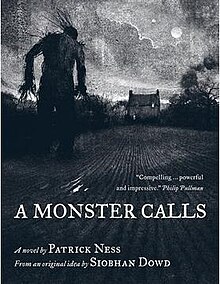
A Monster Calls: a book about healing from grief, the power of story & some ruminations on the teaching of reading

My cousin recommended a middle grades book, A Monster Calls by Patrick Ness, which is stunningly illustrated by Jim Kay.  I hadn't yet heard of it, but apparently it is causing quite a stir, having already won the Carnegie Medal for literature and the Kate Greenaway Medal for illustration.  It is beautifully written, smart, and the pictures are breathtaking--but it is not for the faint of heart; I cried for over an hour when I finished it, which I do not admit lightly.  There is such beautiful, difficult truth in this book, though, that I find it impossible not to recommend.

The main character Conor has been having a terrible nightmare, which he cannot talk about and does not reveal until the end of the story, that began when his mother started getting treatments for cancer.  In the mean time, a monster begins showing up at 12:07 every night, claiming that he only comes walking in matters of life and death. Conor has no fear of this monster because in comparison to his true nightmare, he isn't scary at all.  The monster tells him he is going to tell him three stories, which are "the wildest things of all...Stories chase and bite and hunt," (37) and then, he says, Conor will tell the monster a story--his story, his truth, what happens at the end of his nightmare, that he cannot tell anyone.

What is brilliant about the book is the way the monster interacts with Conor and the way that the stories he tells symbolize the complexity of what it means to be human--Ness has crafted a story that gets at the heart of pain and healing in a way that is significant and weighty and truthful for both 12 year olds and adults.  Through the narrative voice of the monster and his stories, he approaches life's biggest fear--loss--in a heart wrenching, beautiful, and most important, truthful, way.

After the first story, they have this exchange:  "So the good prince was a murderer and the evil queen wasn't a witch after all.  Is that supposed to be the lesson of all this? That I should be nice to her?" He heard a strange rumbling, different from before, and it took him a minute to realize the monster was laughing.  "You think I tell you stories to teach you lessons?" the monster said.  "You think I have come walking out of time and earth itself to teach you a lesson in niceness?" (63).

This reminded me of some of the work I recently did at the Teachers College Reading and Writing Project's summer institute for the teaching of reading.  One of the best ongoing conversations at multiple sessions was about how students often don't do the reading work that will move and change and transform them as people--they look at a complex text and often want to reduce it to the first lesson they can come up with--but this is empty work when in a rich text.  Life--and the best kinds of stories--are far more complex than to reduce to a single lesson.  And it is a sad day when amazing books get reduced to looking for a lesson (which seems to be what standardized testing is trying to do to reading--reducing it to a task, rather than an opportunity to understand what it means to be human, what it means to belong, to escape from reality for a moment, I could go on).

Conor goes on to say: "I don't understand.  Who's the good guy here?" The moster replies: "There is not always a good guy.  Nor is there always a bad one.  Most people are somewhere in between." Conor shook his head.  "That's a terrible story.  And a cheat," (64).  This is where so many middle grade students find themselves--and because they have been trained to look for the "lesson" on a standardized test, or because for whatever reason they want to look for the easiest way out of a story rather than linger in what it is really offering.  The rest of the story follows Conor navigate and make meaning through the darkness in a way that stunned me as a person.

Like the monster says, stories are wild creatures.  They help us see.  They help us heal. And I love that it is my job to get books in the hands of kids and to teach them how to make their thinking messy, because that is how life goes.


Sunday, May 27, 2012

Streets with names from the Middle Ages and other thoughts on roots.


Tana French is a phenomenal, literary mystery writer and my mom, brother and I have enjoyed all of her books.  I read her third, Faithful Place, earlier this year and for some reason never wrote about it, but still find myself thinking about these words from the final page:


"All that night...I went looking for the parts of my city that have lasted.  I walked down streets that got their names in the middle ages...I looked for cobblestones worn smooth and iron railings gone thin with rust.  I paid no attention to the shoddy new apartment blocks and the neon signs, the sick illusions ready to fall ...In a hundred years they'll be gone, replaced, forgotten."


  I'm in the middle of our last unit of the year, Reading and Writing Through the Literary Genre of Coming of Age.  We are obviously focusing on the adolescent coming of age, but I have found that life continues to spiral me through many comings-of-age. We read 8 short texts of a variety of genres together and they are all reading a coming of age novel of their choosing.  We are having two class-wide discussions, dividing the books in half.  This means that this week discussion revolved around struggle and we have watched all of our characters wrestle with the fact that growing up is equated with pain and finding ways to cope and survive when the safety and blissful ignorance of childhood is pulled away.

This is what brought me back to these words from the protagonist of Faithful Place, because I think to survive well means to have a life rooted in things that last.  The imagery that French employs is so poignant to me--especially the "sick illusions" that  call me to temporary, shallow wellness, which is what we are seeing in class from our adolescent protagonists on their way to finding something deeper and real.   I cannot wait to talk about hope next week and the kinds of things that bring resolution from life's messes. It never ceases to amaze me the way that talking about literature with 13 year olds on a regular basis always brings me back to truth.

Sunday, April 22, 2012

the "added value" of literature: an amazing op-ed in response to the state ELA test

This was a crazy week.  I watched my students spend 9 class periods in silence over the course of 3 days while taking the state ELA test (and they have 9 more this week for math).  Then I listened to them talk non stop about "The Pineapple and the Hare" (that's a link to the google search if you haven't read about it yet), the most controversial reading passage we've seen yet on the state test.  My colleagues and I mulled over two of the six questions for our 45 minute weekly meeting, which happened to be later that day.  Our thoughts at the end were that literature and multiple choice just don't go together.

The New York Times published this op-ed today by Clare Needell Hollander, a New York City middle school English teacher that encapsulates everything I've been thinking about this week, rooted in her experiences running literary book clubs with her students.  It brought my thoughts back to the book club meetings that took place in my classroom this week on Monday and Friday that had been clouded in my mind amidst the state test nonsense.  We finally got to talk about Night by Elie Wiesel, and the ways in which my students read this book were incredible, and trying to summarize the conversations I had would rob them of their beauty and depth.

All I know is that if you put solid books in the hands of teenagers, lives and brains and hearts can change and that you should read this article right now.


Monday, March 19, 2012

Maus and Night: think through WWII and literature with my 8th graders.

The next student book club in my year long line up is Holocaust Literature with graphic novel Maus by Art Spiegelman and the memoir Night by Elie Wiesel.  I've spent the last month or so reading and trying to figure out how to approach these topics with 8th grade students, wondering if I should have picked an "easier" period of history, (but is there one that isn't filled with darkness?).  While I was rereading Night for the first time since 2004, I kept stopping and wondering if 13-14 year old students were emotionally ready to visualize and process the Holocaust.  I ended up writing a letter to parents making sure that they were ok with the human depravity depicted in the book as well as Wiesel's spiritual struggles.  Every parent agreed and I still fall confidently in that literature is one of the best ways to study history, and where better to learn how to process humanity than in a book club?


We started today with a general overview of World War Two.  Just reading a page brought up some incredible discussions questions:

What happens when a country is focused solely on itself? When is isolationism or distance a healthy choice? Unhealthy? Do the same principles relate to an individual's life?

How do leaders like Hitler and Mussolini gain power? What kinds of situations cause people to look to leaders like them?

Winston Churchill said before the war: "Britain and France had to choose between war and dishonor.  They will have war."  We asked questions like: What does this mean? What kind of dishonor is he talking about? Then my students started making connections with this and Terrible Things, the picture book by Eve Bunting that we read during our Social Action unit: that stopping wrong things only when they begin to affect you personally is ethically wrong and made the connection that Churchill believed that looking the other way was dishonorable.

I was so inspired by the energy emitted from my students today and I cannot believe that for a while I doubted whether they would be ready to face such ugliness.  Their insight was incredible and they have not yet even begun to read the books.

The article we read ended with a quote from Franklin Roosevelt, written for a speech that he never got to deliver: "Today we are faced with the preeminent fact that, if civilization is to survive, we must cultivate the science of human relationships--the ability of all peoples, of all kinds, to live together and work together in the same world, at peace." Our conversation wandered to my classroom value, posted on the wall, that everyone has a story--and once we get to know that story, we can begin to relate to, empathize with, and care for and understand that person.  All I can say is that studying history well makes us better people.

Miss your old English class?  Read (or reread) Night and/or Maus.  I really believe it is one of the most important works of literature I have ever encountered.  Think through the questions we will be thinking about in our book club:

What is the value of difference? Of human life?

Do the hard truths of human history still impact us? On a corporate level? On an individual level? How? Do you let them impact you?

Why create literature and art in response to history? Why study history through literature and art?

How do we emotionally [and spiritually] process through our history as a people?

Sunday, February 19, 2012

defining love in an 8th grade english class.

I think it is a very small contingent of people who go into secondary english education and want to teach in a middle school.  Most of us dream of opening the literary eyes of high school students--the kinds who are past the stage of their hormones being new, the kinds who are starting to think critically about the world around them and their future in it.  Before I ended up at my school, I think I applied to every high school in Manhattan, none of which were looking to hire me.  Through a friend of a friend, I rode the train to Brooklyn for the first time a week into the school year for my interview and figured teaching middle school was much better than day-temping and evening-barista-ing I'd been doing for months.  That was almost 8 years ago and every year I get reminded why 8th grade students are amazing--and this year's reminder is, not surprisingly, rooted in the epic-reread-bookclub of Harry Potter and the Deathly Hallows (uber-nerds see this).

Every student chooses one of five books to read with me at some point during the school year.  Last year we had so much fun in the book club that I decided it was definitely worth it to do again, even if there wasn't a movie release to celebrate along with it.   That brings me to this week.  (I'll be talking across some of the best plot and character moves in the series, if you haven't read the series yet and you don't want to ruin your life, I wouldn't read anymore.  Then I'd go out and start reading. Anyway.)

{usually I wouldn't pick a movie picture
for a post about a book, but I do love the
movies and I think Alan Rickman is
brilliant.  Am I right, Nora?} 
Severus Snape is barely present in person in the last book of the series, though he is all most readers are thinking about after the close of book six when he committed an act of violence that broke the heart of every reader: either Dumbledore was wrong about him all along (and at the time, the very idea of Dumbledore being wrong about anything was unthinkable) or his trust in Snape had roots in something we did not yet know as readers.  I spent a significant amount of time between finishing The Half Blood Prince in July 2005 and starting The Deathly Hallows in July 2007 repeating to myself: I trust Dumbledore.  I trust Dumbledore.  I think that reading the backstory at the end of The Deathly Hallows is one of my favorite excerpts that I've ever read: Snape sacrificed himself, his pride and his ideas for love.  

In our book club we starting talking about how the character of Snape redefines for the reader that love, as demonstrated in entire series, is not about what someone else can do for me or how someone else can make me feel, but self sacrifice.  I watched as these 13 year old minds began to turn this around in their minds and all of a sudden they begin to discuss the other places in the book where this is present.  The first one that came to mind was, obviously, Lily Potter sacrificing her life for Harry, which is something that gives strength and power to Harry throughout the entire series.  We discussed that our empathy for Narcissa Malfoy begins when we see her begin to doubt Voldemort out of love for her son and ultimately chooses to risk her life in betrayal at the end of the series.  And then there is sweet Dobby who sacrifices everything. 

Love means sacrifice.  Love means self-forgetfulness.  And there is nothing better than hearing this from 8th graders, believed by many to be the most self centered age group in America.  


Sunday, October 17, 2010

Harry Potter is just too big for a blog.

www.akindoflibrary.blogspot.com

I was mortified when I realized that I haven't written on this blog since September 30th.

It's definitely not that I haven't been reading, but I think it's because I've been reading so much for school: my students have all created their own reading blogs and since it's so early in the process I feel compelled to read them all 93 every week, which has been happening over my Saturday morning tea rather than writing about my own reading experiences, per usual (which must change). I've also been preparing for the book clubs that are starting up in my classroom. This is the first time I have attempted to be in book clubs with students all year long.  A little crazy.  My brain has been consumed lately with Harry Potter and the Deathly Hallows.  While my reading focus has been on what my students' book club experiences will be like, I also realized that there are depths to be mined in old Harry Potter.  I've been overwhelmed by all of my thoughts that I have no idea where to begin, and this has snowballed as I've been reading multiple essays in Harry Potter and Philosophy and Reading Harry Potter: Critical Essays.

That being said, I'm currently looking to reinvent some healthier rhythms that don't involve quite so much work *and* I promise I'm on a mission to draw some serious conclusions about Harry Potter (though, I can say that I'll be rereading this series for the rest of my life, so I suppose I don't have to discover them all now).  For now, here are some of the biggest Harry Potter threads going in my brain (please do not continue reading if you have not read the entire series, and on that note, if you haven't read this series, I'm not sure what you're waiting for):


  • The fact that since we are able to be inside Harry's brain, Rowling brilliantly creates a narrative in which most readers begin to trust all of Harry's thoughts and the conclusions he draws, especially about Snape, and especially in retrospect in light of the ending of book 7. 
  • "In book II, Dumbledore tells Harry that the essence of one's character is defined by what one chooses to do rather than by any inherent ability...by Dumbledore's standards, is [Snape] not an even greater hero than Harry?" (from Cruel Heroes and Treacherous Texts, Schanoes)
  • "Both Snape and Black complicate a black and white moral schema. Where Snape forces the reader to accept a bad person who chooses the side of good, Black forces us to acknowledge the potential for violence and ruthlessness that can exist in a good person." (from Cruel Heroes and Treacherous Texts, Schanoes)
  • The character arc of Neville Longbottom, and the development of Harry, Ron and Hermione, obviously. 
Tomorrow the Harry Potter 7 Reread book club begins their "pre-club" thinking work...developing the narrative arcs of the first six books in order to provide a foundation for our approach to book 7. My guess is that my conclusions won't be totally drawn until I've talked all this through with my brilliant students.  My hope is that I will be posting on the other aspects of my reading life before then, though. 

Monday, June 28, 2010

Look out.


My after school creative writing class this year was hands down one of my favorite parts of my teaching career.   These rock star middle school students each wrote a piece to be published in our anthology and I'm making the prediction here and now that this is only the beginning. I will be the one waving around short stories in the New Yorker and newly published novels claiming to everyone I know that once upon a time these fine writers were in my class.  These ones made my Thursdays, made my jaw drop with their creativity, made me laugh. I just adore them.  So, all I'm saying is that this anthology was one of my best reads of the year.

Thursday, June 10, 2010

inspired.

Every time June rolls around, I think back to five years ago after my first year teaching when I had applications in at 10 different high schools in the great state of Ohio.  The plan was to go to New York for a year or two and then travel back to "normal" life in the midwest.  A handful of reasons were pulling me home, and yet I couldn't bring myself to make that decision final.  Then. I went to my first June planning meeting, where a team of teachers plans the next year's curriculum.  I realized then how lucky I am to have such inspired colleagues and a job that lets us re-envision what we're doing each year.

Last year the 8th grade team planned a new opening unit based around revisiting favorite books from childhood, with the intention of reigniting the kids' passion for reading by teaching how to dig deeply into books they long ago adored.  Today we re-imagined this unit and I walked away with a pretty sweet re-reading list and I am so antsy to start working on this pile and, like the nerd I am, annotating and writing about them in preparation:


Then my team took a walk to the bookstore and made a list of books to order for our classroom libraries...it was so fun thinking about what books my current rock-star 7th graders will want to read in the fall as 8th graders. And, let's be honest, I'm pumped to read them all, too.

And, let's be totally honest, I'm also counting down the days until June 28th.  Everyone needs a summer vacation to rest, relax and reinvigorate. Sigh. I love my job.

Sunday, February 7, 2010

My mind is about to burst! or, Where do I put all that I have to say?

One of my favorite things going on in my classroom recently are my students reading responses.  Stay with me, I promise this whole post isn't all about teaching.  In an effort to ignite some passion into my students' reading and "writing about reading" lives, I've been doing a weekly reading response where students share their entries out loud with the rest of the class. Not only has it provided a real "audience" and given them motivation to write something they are proud to read, we've been asking questions like what goes into a good reading response? What invites a reader into your writing? 

My 7th graders are basically all stars.  Many of them have started their own reading blogs (heart!) and are growing in sophistication...which makes me scramble for new ways to teach into writing well. This has caused me to think about my own writing process for this blog, in an effort to coach into what writers can do. This is what I've found: (1) I reread all of my underlined notes and dog-eared pages, typing ones that seem weighty into a new post page. (2) I read the ongoing conversations about the book online to help me gain a context/find insight I may not have considered on my own. (3) I try to pull a thread from all of the above to focus on for my post...or, try to choose what might be the most important thread to pull.

The point of this post, is that there are often way too many threads.  Sometimes I miss being an English major so much it hurts because all I want to do is write and talk about books in classes that meet three times a week.  Sometimes one post per book isn't enough (unless people want to read crazy long posts, and let's be honest, I think my parents might be the only ones who would really read every word I wrote. Because they're awesome.) Anyway, you may begin to see "outlier" posts that are less about the book itself and more about some of the ideas that came up within it that I need to think through. I also blame this on the amount of Young Adult fiction I read...when I finally spend time in books on my own reading level, I don't know what to do with myself! 

Anyway.

Sunday, December 6, 2009

Inspired to Teach Research in Writing.

There has been a burst of popularity in books that are written in verse: Ellen Hopkins and Patricia McCormick are two of my students' favorite authors who use this technique.

Yesterday I read a completely different Young Adult book in verse called Your Own, Sylvia by Stephanie Hemphill. Though a work of fiction, Plath's life is highly researched and her poems studied in depth.  It is set up chronologically, structured by poems "written" by a cast of characters who knew Plath from her mother to ex-boy friends to psychiatrists to, of course, Ted Hughes.  Each of the poems written by a "character" include footnotes about Plath's relationship to and history with them and where she found the information. Hemphill also writes poems  for Sylvia herself, all of which are modeled on one of Plath's own poems, which she footnotes.

I've been thinking a lot about teaching creative writing lately.  My curriculum is filled with it (short story, memoir, poetry, journalism), I've incorporated "independent writing" into my time with my 7th graders (where kids have the freedom to write whatever they want to write and my teaching is about the process of combining passion with the management of a "publishing" deadline), I've applied to teach it at a summer program and I currently have some amazing students who meet for hot chocolate and writing in my after school program (see picture. they're great.).

Not only was this book a really creative introduction to the life and complexity of Sylvia Plath, but all I could think about while reading it was how this could be an amazing "mentor text" for my students as writers, or a text that serves as a model for a genre or craft.  In our independent writing publishes, many students have attempted the "journal style" of writing and creating poetry anthologies, but I haven't seen a book attempted in verse...or based on research.  The research part is exciting because the 7th grade team has incorporated it into our fiction unit and I think it will really raise the bar of story writing in our classes.  I can't wait to share the structure of this book with students and see how it inspires a handful of them to try something new.

Monday, August 31, 2009

Last day of August. Summer reading update.

www.akindoflibrary.blogspot.com

Good things: drinking tea. wearing a hooded sweatshirt on a 65 degree August Monday morning. the windows wide open.

I just checked my list of books I wanted to read this summer and checked off *one* of them. Ha. This is not to say I didn't read this summer, but my plans went awry...

Here's what was actually read this summer: a mix of old and new young adult, old and new literary fiction, a few guilty pleasures, one new absolute favorite*

Rereads. I couldn't help myself.
From the Mixed Up Files of Mrs. Basil E. Frankweiler
Charlotte's Web
Anne of Green Gables
Harry Potter and the Half Blood Prince
The Summer Book
Pride and Prejudice

New Reads
The Guernsey Literary and Potato Peel Society
Evening
The Elegance of the Hedgehog*
The Savage Detectives
Trail of Crumbs
Hurricane Song

Even though school doesn't officially start until after Labor Day, this week is going to be filled with prep work. I still get beginning of the school year anxiety, but I confess that I am kind of excited to meet the 90 kids I will be spending at least 1500 hours with over the course of the next 9 months. And. I love that my job is to get kids excited about reading and writing. I love asking kids what their absolute favorite book they have ever read it. And yours?

Thursday, June 11, 2009

For the love of reading.

June planning is half of the reason I still live in New York. The time at the end of the year when my department at work reflects on the past year and begins making plans for the next. I suppose it's a sign that I'm in the right profession, because every year the idea of re-imagining how to help kids love reading and writing is incredibly energizing. Five years ago probably this week I was deciding whether I should move back to Ohio or stay in New York. My first year of teaching was a circus: teaching 3 different subjects, two grades and not having my own classroom, I was literally beat. But when my team sat down to talk, I realized I actually had insight, rather than my typical sitting at meetings and soaking in other people's advice and ideas. Planning was a creative outlet for me. So I stayed, excited for the next year (and an all 7th grade ELA program, obviously)...and the prospect of living in a bug free apartment with two of the greatest friends in the world (the other half of my reason for staying.)

Anyway. My 8th grade ELA team's June planning has been so invigorating. In our re-imagining of our reading curriculum, it has left me wanting to do nothing but read. Truly. 8th grade reading is mostly about going deep, making connections and being excited about the ideas you find. In order to teach into this idea, we are revisiting old favorites from childhood and reading them with a closer lens--teaching skills for close, thoughtful reading with an incredibly accessible text. Then they can practice in a childhood re-read of their own, then apply the skills to their on-level reading. Make sense? Stay with me for why this is relevant to you.

Our read aloud is Charlotte's Web. Yes, the book that you probably read in second grade. But. You have no idea just how thought provoking, well written and life-giving this book is. The teachers are also reading "The Annotated Charlotte's Web" in preparation, which includes a ridiculous amount of information on E.B. White, his overall brilliance, writing craft and the tracing of themes. This facilitates "reading like a writer" better than any text I've come across. I can't wait to talk about this with my students. But. The greatest part:

After our students have read Charlotte's Web with us, and have re-read a childhood classic, they will write an "appreciation." A colleague found these forewords in Penguin's Children's Classics: an author writes about his/her childhood experience reading the book and what it means to them as an adult. It has been so much fun talking about our favorite reading experiences as children: The Little Princess, Anne of Green Gables, The Wind in the Willows...We can't wait to give our students the opportunity to revisit these books and write about their experience with them the first time and what it was like to reread them as young adults. Sigh. It just takes me back to the world of imagination when playing pretend felt so real.

You should seriously consider going back to some childhood favorites and rereading them. I'm convinced that they help remind us of all that is good and true. I just love how reading can change us and shape us and I am forever grateful that my parents "forced" my brother and I to read every night before we went to bed...a habit I never grew out of. I'll post my "appreciation" later this summer. I'd love to hear about the books that defined your childhood. Reread and remember.

I love books.

Wednesday, March 18, 2009

It's spring in Brooklyn and why 8th graders are amusing to me.

First, a note on the weather. There is something truly great about walking down the street in Brooklyn on one of the first 65 degree days. I swear, light feels more real and the buildings look different as the old timers pull out plastic chairs to sit on the sidewalk. Spring officially starts on Friday. Ok. Just had to get that out.

Second, I have to share one of my favorite, most laugh out loud moments as a teacher:

Background: We are currently in the depths of Romeo and Juliet. The namesakes have fallen in love/lust. Mercutio is dead. Tybalt is dead. Our class conversation yesterday revolved around violence: how something light hearted and entertaining can turn disastrous when a weapon is pulled, or how easy it is to cross the line when "the mad blood is stirring." I always share the idea that in Romeo and Juliet "it's all fun and games until Mercutio dies." And yes, my 14 year olds had some excellent insight into the issue.

Today, since it was so nice out, kids were all over the place after school: sitting outside every local coffee shop and park, so obviously I ran into a few and they called me over: Ms. Robbins, you'll never guess what he did! They proceeded to tell me how a boy in my homeroom was trying to get ready for gym and they were horsing around in the locker room around a door that didn't have a handle. There was pushing from both sides, each boy on either side trying to alternately close or open the door to block the other. Then. The boy in my homeroom slammed the door not realizing that the other kid's fingers were in it. Ouch. And no, I am not heartless, this is *not* the laugh out loud moment. I hope that poor boy is ok. The humor came when the boy in my homeroom said:

"It's all fun and games until Mercutio dies, Ms. Robbins."

Saturday, February 7, 2009

A clarification for the poetry you (maybe) read on this blog.

Yesterday the 8th graders had a poetry slam to celebrate the collections they published and all the life changing reading experiences they had (ha. I wish) during our unit. It really was one of my favorite moments of this year so far, though. 14 year olds willing to share their writing in front of 90 other students, and 90 other students willing to listen.

Teaching poetry is my metaphorical spring. I love finding ways to reveal just how life giving and refreshing reading it can be, and all of the opportunities for creative expression and freedom in writing it. One of my teaching goals for the year has been to write along with my students, which is hilarious because my students are precious enough to think that everything I write is amazing. I am obsessed with revision. I try to arm students with strategies and encourage experimentation. As I was trying to model what experimentation looks like, I ended up learning a lot about myself as a poet.

One, I like powerfully descriptive language in prose, but I don't like to overdo it in poetry. I've found that the poetry I am most excited about writing is when I try to capture a single moment in words and simultaneously give the reader a picture of what was happening while conveying its emotional weight. I tend to do this mostly through steam of conscious-style writing paired with meaningful line breaks. I love how one single image can speak volumes beyond itself.

So as I was experimenting with my own work in front of my class, I found I didn't like a lot of the revisions I was making when I was intentionally trying to include poetic devices. Granted, my rewrites were way better than the deliberately bad poems I started with, but they did not seem to have my voice and identity in them. For this reason, I didn't "publish" a collection with them, because despite my best efforts and seeming "good" revisions, I felt like a fraud.

This caused me to take a look at the poetry that I have written, and then feel compelled to explain it. Two of the most influential poets in my life are Pablo Neruda and Jack Kerouac. Neruda's use of language--even in translation--is musical without music, deeply beautiful at once transcendent and cascading and I always imagine someone who is talking with such deep passion that he forgets to breathe. (please read for an example. or google Sonnet 17.) Kerouac's western haikus are the pared down version: "Above all a Haiku must be very simple and free of all poetic trickery and make a little picture and yet be as airy and graceful as a Vivaldi Pastorella." He was able to get "the rendering of a subject's essence, and the shimmering, ephemeral nature of its fleeting existence," (Weinreich):

Frozen
in a birdbath,
a leaf.

My hope in my own poetry is to work toward combining these two styles; to try to convey the weight of a nuanced image and the way my heart can just drop to the ground, but in the good kind of heartbreak. I'm not sure that I felt I had to write this to justify my writing style to you, but more as a means to process through who I am hoping to become as a writer?

To close in another's words, an excerpt from anArs Poetica that I found recently. It seems to almost perfectly describe the art of capturing of a fleeting moment that becomes timeless and heavy:

Ars Poetica by Archibald MacLeish


A poem should be wordless
As the flight of birds.

*

A poem should be motionless in time
As the moon climbs,

Leaving, as the moon releases
Twig by twig the night-entangled trees,

Leaving, as the moon behind the winter leaves,
Memory by memory the mind—

A poem should be motionless in time
As the moon climbs.

*

A poem should be equal to:
Not true.

For all the history of grief
An empty doorway and a maple leaf.

For love
The leaning grasses and two lights above the sea—

A poem should not mean
But be.

Tuesday, January 20, 2009

Inauguration narrative. Another reason why 8th graders aren't totally jaded.

One gym.
Five hundred
Thirteen year olds.
One overloaded server.
So. Instead we plugged in.
8 inch black and white,
held a microphone
and listened
(Most) of them)
to our president
the old fashioned way.

And it was beautiful.

Wednesday, December 17, 2008

Wonder.


I spend my days with thirteen year olds. Most people make very strange faces at me when I tell them this, followed by some sort of apology. This post is dedicated to all you cynics out there. 8th graders rock and here's why:

Yesterday my student teacher was running the class. His back was toward all of the windows. All of my students and I were facing him--and all the windows, obviously. All of a sudden, the little, teeny snowflakes that had been falling all morning turned into these enormous near-hyperbole snowflakes falling from the sky. I noticed my students drifting away and staring and then I, too, got distracted. I had to ask my student teacher to stop so that we could have a two minute celebration: literally all my students rushed to the windows and I couldn't have wiped the smiles from their faces if I had tried.

This. Is why I love my job.
This. Is proof that 8th graders don't always want to be jaded.
This. Is what helps me appreciate the winter.

Tuesday, October 28, 2008

Reading like a writer. And like a reader. And like a teacher in The Secret Life of Bees.


Two things. First, I mentioned this weekend that I reread The Secret Life of Bees to bring my reading self back to life. Sigh. Second, my teaching life has been incredibly energizing this year. I'm obsessed with my 8th grade Reading and Writing team...we've been diving into the craft of teaching and have all been writing in order to study the process of real writers. It has been inspiring and motivating. So it's no surprise that this post is about the Secret Life of Bees and inspired by school. I'm a dork. I can't help it.

My students' homework assignment today was to write an entry in their notebook about their current reading life. To model, I talked about how I had to abandon a book and read an old favorite to get back to my reading "zone" (a term that only middle school English Language Arts use. Sorry. Ever gotten lost in a book? That's the zone! Ha.). I told my students that my "purposeful paragraphs" were going to be the background information about my recent reading state and how The Secret Life of Bees inspired me as a reader, and as a writer. And, to further attest to my needing help, I decided to do the homework, too. On my blog. So.

As a reader. First, this book is a treat to read. Sue Monk Kidd's descriptions name emotions that previously had been unnameable to me: "I didn't know what to think, but what I felt was so magnetic and so big it ached like the moon had entered my chest and filled it up." This is also a book about women who share a sisterhood--and there is just something about having amazing girl friends that resonates when the Daughters of Mary come together in this story. I love the strength that they offer to one another and the tender wisdom and patience they offer to the motherless Lily. And, Lily and August are lovers of literature and words. Writers and readers are cut from the same branch--because they know that the people who read their books are the kinds of people who love books (see The Book Thief, House on Mango Street, A Tree Grows in Brooklyn...). "Really, it's good for all of us to hear it again," she said. "Stories have to be told or they die, and when they die, we can't remember who we are or why we're here." Man. There aren't words (I don't know what to think, but what I feel is magnetic...aye.)

As a writer. My writing took a backseat for most of the summer, which was quite tragic. But as the fall usually does, inspiration creeps in and I once again have that feeling where I need to have a creative outlet for all that's going on in my head. What I have been thinking the most about lately is how to capture complex emotion. Lily Owens is so well written...it is almost like therapy reading this book. She begins as just a girl, curious and broken. I can picture in my head the prewriting that Kidd must have done to develop her so poetically and realistically. I want to create rich characters. Right now. I also love how throughout Lily's "coming of age" that August Boatwright is just steady and solid and wise. She is not the kind of annoyingly perfect kind of woman, but one who is seasoned and has spent some serious time reflecting. Lily and August's relationship is so so beautiful to me.

As a teacher. Coming of age stories never get old to me. And I don't think this is mutually exclusive with being a teacher of children who grow up in front of me. But. I cannot wait to talk with some of my students about this book...about how Lily responds to her life and how she changes. The metaphors are so rich and life giving. I'm excited to hear how girls respond to this, because again, I don't know what to think, but what I feel is magnetic.

(and no, I don't think I can see the movie, as much as I love Alicia Keys. I just don't want any of the pictures in my mind to change. Sigh.)

Tuesday, March 25, 2008

[How] to be or not be...a teenager. According to Romeo and Juliet (and some fantastic 8th graders)

For the past six weeks, I have been delving into the story of the world's favorite star crossed lovers. I've mentioned before that this posed a huge challenge for me as a teacher because it took my until graduate school to really really love Shakespeare and understand his depth, brilliance and relevance. Much to my surprise, my students were ready for William and have gobbled up the play and our discussions. We are nearing the end and had a debate today about whether Juliet was courageous/bold/romantic or rash and stupid. Things got a little heated, and as I was listening, the conversation became very interesting. They didn't realize it, but they were analyzing what it is like to be a teenager and to be pressed with choices that may affect the rest of their lives. I thought I would share some of their insight and questions. After hearing what they had to say, I had no choice but to think about their points. Hopefully I can prove just how briliant 8th graders (yes, 8th graders are) and show you how valuable it is to listen to what they have to say.

Parent/Child relationships:
Juliet is open minded toward her parents' ideas in the beginning of the play, but this changes as she becomes engrossed with her relationship and secret marriage to Romeo. Then we see a Juliet who is very courageous standing up to her parents. The unfortunate part is that though she refuses to marry Paris, she isn't open with them about her love for Romeo. Enter complexity. How open should children be? What role do children/teenagers have in making decisions about their futures? How does culture play into this?

Juilet's father wants Paris to "woo" his daughter and win her heart in the beginning of the play, rather than marry her right away. He seems to understand his daughter. Then he appears to be a completely different person as he rages against her in her refusal to marry Paris after Tybalt's death. What are his true feelings toward his daughter? Was is right for him to demand this marriage of her since he thought it in her best interest? Could he have presented his request in a different manner? Would it have changed the outcome of events? How sensitive do parents and adults have to be when dealing with teenagers who are in between childhood and adulthood?

There are quite a few adults who give both Romeo and Juliet advice. Students noticed that Juliet seemed to only listen to what she wanted to hear...and both threatened suicide when they weren't hearing the answers they wanted. How do adults talk and reason with teenagers who may be blinded by passion? Even if the adults can see that the passion is because of youth, how can they be convinced that the feelings are very, very real?

Young Love:
Is is possible to love someone when only knowing them for a few days? Is love at first sight real? Can you trust the emotions that exist at the beginning of a relationship? What is love? Do Romeo and Juliet know what it is or means?

How can she believe what Romeo has to say and the promises that he is making? Isn't there a chance that he has ulterior motives?

Students argued that Juliet was being rash because she had no life experience to judge her decisions by. They debated whether she could trust herself to know what she was doing. Some students thought that she was being young and stupid (followed by, and I quote: "We're young. We're stupid.)

Students raised the question of suicide again in relation to this passion...is this violent passion understandable or just merely dangerous? Would it change if they were adults?

Is living in the moment brave or completely ridiculous?

Wrapping Up
Of course, as literature often goes, there is not an "answer" to any of these questions. We left it as food for thought...to critically examine these complex relationships and events...to dig into these fictional moments and pull from them what we are able. Such is the reading life.

Sunday, February 11, 2007

A Joy of Life.


Technology savvy I am not. This is a post for me to play around with adding pictures. This is of Julie, me and Jenna last July at the Eagle and Child in Oxford, England. (Did you read the New York Times travel section today? It's mentioned on the front page.) This is where The Inklings, Tolkein, CS Lewis and friends, would meet to talk literature. Needless to say, besides the fact that we spent our entire trip traipsing around the English countryside reading and drinking tea, being the nerds that we are, we were quite excited to visit the pub where our literary heroes met.

Sigh. I think that's half the reason why I love my job so much. I get to talk with kids about books all the time. It is amazing to watch the way that reading can change the way we view so much of the world. I belong to a somewhat overachieving book club. We meet every week in Brooklyn after school. We have processed through topics that otherwise would have no real voice in my life: post-colonial India, the role of memory, the Black Plague, what motivates people to action. I walk away thinking every time.

So, if you haven't gotten the hint yet, here are a few book club recommendations:

Atonement by Ian McEwan
Cry, The Beloved Country by Alan Paton

Or, here are my current books on deck. Let me know if you want to read:

East of Eden by John Steinbeck (my book club's next pick)
To Kill a Mockingbird by Harper Lee (teaching it to the kids!)
The God of Small Things by Arundhati Roy

Go read with someone. Seriously.