Showing posts with label book club. Show all posts

Saturday, June 15, 2013

Summer Reading List & Notes


Each June I marvel at the fact that I have a job that affords me the opportunity to end a cycle, refresh my mind, and freshly begin again in September.  One of the ways that my mind refreshes itself the most is through getting lost in reading and being outside, so each June I revel in the creation of my summer reading list.  My last day of school is June 20th, as I'm taking a day off to travel for a wedding shower in the great state of Ohio, and I'm participating in 2 of the Teachers College Reading and Writing Projects summer institutes, which will end on July 5.  Technically my days of freedom start July 6th, but it does take over an hour to commute up to Teachers College, so I plan on getting lots of reading done that way, too.  After that, you'll find me in the park.  

Reading conclusions of summers past can be found here, if you're looking for books I've already written about.  Or, feel free to join me in reading some of the books below.  Outside of my book club, these are unintentionally overwhelmingly female and modern.  Also, as a note, I decided that for summer reading, I could take a break from my New Years Reading Resolution, and could purchase new books.  

Southwest Ohio Ex-pat Former English Majors Summer Book Club: 
Two of my great friends from home and I decided to read together this summer.  We each picked a different book for a different month of summer

June: The Unbearable Lightness of Being by Milan Kundera
July: Ocean at the End of the Lane by Neil Gaiman
August: The Yiddish Policeman's Union by Michael Chabon

Fiction: 
These come from the on-going list I keep on my phone from whenever I am wandering through a bookstore, a habit I highly recommend for those times when you have no idea what to read next or in an attempt to curb an out-of-control book buying habit :)

The Interestings by Meg Wolitzer
Z: A Novel of Zelda Fitzgerald by Therese Anne Fowler (I've been on "Lost Generation" reading kick lately)
My Brilliant Friend by Elena Ferrante (from an imprint that brought me Elegance of a Hedgehog and A Novel Bookstore)

Mystery Books for my August Travels (& an e-book trial run): 
There is something wonderful about having a mystery read while stuck in airports or when flying across the Atlantic (!).  I am also trying something new with these titles and borrowing my fiancee's e-reader in my first-ever attempt to not add 15 pounds of books to my suitcase weight.  I will probably add my August book club choice on it as well.  It's best to travel prepared, you know? I'll write more about my e-book experience upon return, as it's bound to be a bit hard for this lover of turning paper pages.  I'm also trying to encourage public library e-book check out with my students in the fall, so I need to be able to speak knowledgeably by then!

Where'd You Go, Bernadette? by Maria Semple
Life After Life by Kate Atkinson
The Stone Cutter by Camilla Lackburg

Nonfiction: 
Though I'm generally heavy on the fiction, I like to mix it up and I'm pretty excited about all of these

The Girls of Atomic City by Denise Kiernan (Lately I can't get enough of history)
When I Was a Child I Read Books by Marilynne Robinson (the description of this book of essays sounds perfect)
The Autobiography of Eleanor Roosevelt (because I adore her)

Young Adult (this could be a bit ambitious, but that's a good way to plan for reading, right?)
I try to stay somewhat informed about what my students are reading, be full of recommendations, and be knowledgeable about the young adult literature world.  This summer's stack has the widest variety ever, from 50 Cent's novel to a transgender protagonist, to nonfiction picture books and collections about people who helped change and shape the world.  The only one missing is Wonder by R.J. Palacio, because I may have already pulled it from the stack and started it! 


Happy Summer Reading!!

Sunday, June 3, 2012

to run or not to run.

The Marriage Plot is Jeffrey Eugenides' third novel (after The Virgin Suicides and Middlesex) which was released last fall. It follows the college and post graduation life and experiences of three characters: Leonard, with a brilliant mind for both science and philosophy, symptoms of manic depression and a heartbreaker reputation; Mitchell, who has been studying religion and mysticism and is the story's moral center of sorts; and Madeleine, an English major who has situated her life between these two men, most often romantically allying herself with Leonard.  The title refers not just to their own stories, but to the literary sub genre of the marriage plot, which Hanna studies in earnest.  The ending of the book reveals Eugenides' take on it, which I enjoyed, but I wasn't super engaged with the overall plot of the story.

What was interesting to me, though, was when Mitchell was traveling in India for part of the year following graduation.  While volunteering with Mother Theresa's Missions of Charity in Calcutta, he comes across a man there who was a beekeeper from Arizona, with his wife he was still passionately in love with and their children.  "And out of this perfect life had come the need to break out of it, to bring it into real difficulty, even hardship, in order to relieve the suffering of others."  Mitchell was fascinated by this intentional choice and watched as the beekeeper and the other volunteers served the people of the home as a bit of an outsider.  He had an opportunity to step out of the relatively clean space he had carved out for himself in the home to help a man who needed a bed pan and attempted, but when the mess came and he wasn't sure how to handle it, he literally ran out of the home and left Calcutta.

Of course, Mitchell is 22 years old and yet to glean the kind of wisdom that the beekeeper had, so I can't despise him for his act of cowardice.  But it makes me think about how easy it is to talk a good game on the importance of alleviating suffering and walking with people through their pain, but following through is another story.  When it encroaches on one's freedom--time, thought life, expenses both literal and metaphorical--bolting feels like a valid option, especially if you can at least feel good about having tried.  I guess this is all to say that I'm trying to reconfigure my definition of what a good life actually entails--and not merely in word and thought, but in action--not leading a life that is guided solely by comfort and ease, but a willingness to have deeper roots, which will bring both deeper sorrows but also joys.


Monday, December 26, 2011

Reading Year in Review and Top Ten Books of 2011.

My blog is about to celebrate its 5th anniversary next month.  I wrote my first post on January 6th, 2007, partly to slow down and think about what I was reading again and partly in an effort to get more comfortable with sharing my writing in a "public" space (I would like to thank my 4 loyal readers at this time: Mom, Dad, Alison Covey, Kendra Bloom).  Every year when I'm home for Christmas I read every post I wrote over the year and choose the top ten best books I've read.

Usually, it takes me many hours to reread my blog posts for the year. As I read, I take notes and end up with a list at least 20 contenders for the coveted top ten.  I have to do some serious thinking and rereading of posts to decide which books had the biggest impact on my thought life--and then spend some serious time laughing about the nerdy ways I spend my time.  This year was not so difficult.  Sadly, I don't think I can attribute that to any increased coolness to my life, but I do think I have a few answers/self justifications for the reasons why this year I had only 23 posts (2008 holds the all-time high of 97):
  • The spring was filled with YA books that enriched my teaching life and a side project I'm working on, but weren't necessarily significant enough for me to subject my loyal readers (see above) to. 
  •  The summer, normally the two months that I read the highest number of books, was filled with Infinite Jest, a book that I felt I needed to finish before I posted anything about it.  (Then, the fall happened and I still have 5 additional posts about Infinite Jest sitting in my drafts.) 
  • This fall, I got caught up reading books for and with my students. Many of my Saturday mornings, normally my drink-a-hot-beverage-and-write-about-my-reading time, were filled with training for my half marathon.  Also, my book club choice was For Whom the Bell Tolls by Hemingway, which is not a read-before-you-fall-asleep kind of book: I would make it literally 3 pages and fall asleep. I'm finally about to finish it, which I owe to traveling 3 out of the last 5 weekends on U.S. Airways, who does not offer in-flight television.  
All that to say, it is interesting to look back on a year through the lens of reading. I am nerdily excited for what 2012 will bring in my reading life...and the reflections that accompany good books.  As for the Top Ten, I have to credit Margaret, who is the sole other member of my book club, because six of our choices made the top ten list this year. So, in no particular order:

The Hours by Michael Cunningham/Mrs. Dalloway by Virginia Woolf (rereads)
These books have to be paired together and were two of the most thought provoking reads of the year.

Freedom by Jonathan Franzen
This book received an insane amount of press when it was published last year.  Overall, especially because my book club read read The Corrections first, I throughly enjoyed getting inside the mind of Franzen.

Super Sad True Love Story by Gary Shteygart
Not especially well written, but it definitely was the instigator of many great conversations and some science-fiction/technology induced nightmares.

Beloved by Toni Morrison
I think this was the most historically significant, jarring book that I read this year, and combined with its lyrical prose, it left me speechless.

The Diving Bell and the Butterfly by Jean-Dominique Bauby
Short. Beautiful. Inspiring.

Bossypants by Tina Fey
The most enjoyable book of the year.

Infinite Jest by David Foster Wallace
Harder than my book club's run with the Russians a few years ago and encompassing almost all of my summer, this book was well worth it.

A Million Miles in a Thousand Years  by Donald Miller (reread)
This book was a non-fiction, good reminder of all things I love about story and life.

The Summer Book by Tove Janssen(reread)
This book has become one of my yearly rereads and I've written about it a few times.  I spend the quiet, early summer mornings I have at my parents' house on their screened in porch reading just a chapter or two a day so that I can savor and soak in it during my entire visit.  This year it was my respite from Infinite Jest, to make sure that reading was not only speaking into the my academically-minded side of my brain, but also my soul.

The Hunger Games by Suzanne Collins
I read the first book of this series as soon as it came out, on recommendation of our Teachers College professional developer.  I never finished the series because I felt like I knew enough to talk about it with kids and had so many other books to read.  However, after the Epic-Literary-Reread book club on Harry Potter with my students last year, I thought that it would be cool to do the same thing with The Hunger Games this year.  I read these books in about a week and was amazed to see all of the entry points for young readers to have uber literary conversations. I have also been amazed at how many of my adult friends have been reading the series and are eager to discuss. A post-movie discussion party is in the works.

Cheers to reading and a 2012 filled with more writing about it!

Saturday, October 29, 2011

Forever/Pete Hamill

My book club recently finished Forever by Pete Hamill.  I was completely taken by the opening parts of the book where the main character, Cormac, is a boy in Ireland in the early 1700s and finds that his family has been pretending to Protestant, and that his mother is Jewish and that his father is Irish--as in following the religion of the Celtic past.  The mythology and magic of him discovering this reminded me of how much I love reading of magical lore and suspending my disbelief.

The story took a turn after his mother is accidentally killed and his father outright murdered by the same man, and according to the Celtic law, he must pursue the killer and end his line.  This brings him to New York City, where he meets another mystical character who grants him immortality as long as he doesn't leave the island of Manhattan.  His adventures then take the reader through the history of New York, and though I found myself not loving the plot from this point on, reading about how New York has evolved never gets old to me.  Its history is far from the picturesque village and it never ceases to amaze me that such a dirty city with so many functionality problems has become what it is today.

Despite my lack of plot excitement, one part that got me thinking was when Cormac is describing how he dealt with the gift and burden of having all the time in the world.  As mortals with a life span of under 100 years, there is a spirit within us calling us to cherish the time we have.  Life choices can be heart-wrenching because we merely don't have the time to pursue everything we want to do, and there always seems to be a sense of urgency.  Cormac, though, described a mental state of "sludge made up of age, memory, repetition and banality" that his brain had to deal with, precisely because he did have the time to pursue everything.

"Then while trying to learn Goethe, he discovered something about himself. When he entered another language, when he tried to absorb its rules, its nounds and verbs, and above all, its rhythms, the sludge in his brain began breaking up...his mind became swifter, his visions more glittering...Learning to paint was learning to live.  The same was true of the piano..." (393-393).

Even though we often live with a sense of urgency, the urgency often feels misplaced.  Rushing through tasks that should be done with more care, rushing through dinner or coffee with the person we are across from so that we can get to the next meeting, only to come home and crash.  This is my equivalent of brain sludge.  I live in the tension of needing to crash because my days feel so packed--and watching television or a movie seems like the best way to check out of the harried mental state I carry most of the time.  This, though, feels like a false rest--I don't feel fulfilled.  (But let's be honest, sometimes watching four episodes of Friday Night Lights is life giving.)

True rest would be a soul and mind filled.  True rest is not seeing the pursuit of my passions as a task, as I often do at the end of a work day.  Learning better Spanish and writing and cooking and having people over seem like better ways to live well.


Thursday, September 29, 2011

Infinite Jest and Advertising. Or, real goods are intangible.

Infinite Jest is the kind of book that has to be read slowly because not only are there sweeping themes and ideas to keep track of, but there are short passages and lines that speak volumes into American culture.  While I was reading, it was easy to gloss over those small details without considering them in a significant way.  I want to slow down with a few.  Here is one.

"V&V's NoCoat campaign was a case study in the eschatology of emotional appeals...It did what all ads are supposed to do: create an anxiety relieveable by purchase.  It just did it way more well than wisely," (414).

It comes in a section where Hal, one of the main characters and a junior at the Tennis Academy, is "sinking emotionally into a kind of distracted funk."  In what appears to be almost a complete aside with the connection only being that Hal once wrote a paper on the American ad industry, the narrator explains the atmosphere of advertising (as the book is set in the near-ish future).  This particular ad was from a company that created a nation-wide need for tongue scrapers: "when the nation became obsessed with the state of its tongue, when people would no sooner leave home without a tongue scraper and an emergency back-up tongue scraper than they'd fail to wash and brush and spray."

A. This is hilarious,
B. but DFW's sense of humor is not what I want to write about, though maybe over coffee some time?

His tone and manner of addressing the absurdity of such aspects and culture is so nonchalant and un-ironic (and reminds me of his essay A Supposedly Fun Thing I'll Never Do Again)--as though he is pointing out the obvious.  Yet, it is obvious only in the subconscious that we hardly ever bring out to play, because life is easier when we don't listen to it.

How did it happen that we know our next purchase will not satisfy anything within us and yet we continue to believe and act on the hope that it will?  Why is it easier to believe and act on the promises in advertising than it is in the life truths we claim to profess?  What is going on in our brains when we feel great after buying something new? Why is retail therapy a thing? That people joke about?

We are ridiculous.

I want to drink from a well of Life.

Monday, September 5, 2011

Infinite Jest: a very general response to a very specific novel.

www.akindoflibrary.blogspot.com

I read Infinite Jest by David Foster Wallace from June 1st-August 8th this summer, with just a 3 day break to read My Name is Asher Lev and a chapter each morning on the porch of The Summer Book while I was in Kentucky. I reread Anne of Avonlea right after to let my brain recover/not commit to anything super literary while trying to unpack this brick of a book (that I am thankful to never have to carry in my purse ever again).  All that to say, my summer reading looked very different from my usual devouring of books.  It was as if I were in a committed dating relationship with Infinite Jest.  I was talking with a colleague before school ended whose boyfriend had read the book and when he was half way through said: "Oh, I get it.  The infinite jest is that I am still reading this book."  There were many times I felt the same way.

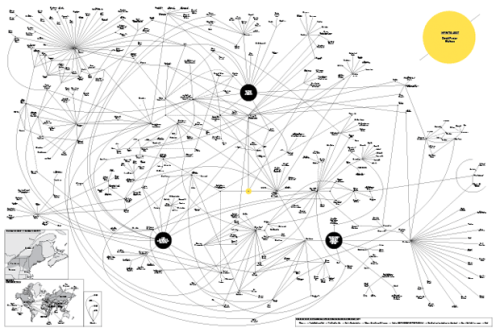
The main conclusion that I came to after finishing its 981 pages of tiny type narrative and 96 pages of even smaller type footnotes is that it is the kind of book that needs to be read twice.  (Crap.) Though I'm sure there are geniuses out there who could keep track of all the characters connections (see poster below by Sam Potts) and narrative threads (see digram below by in their minds while reading, but I was not one of them.  I've probably spent 5 or 6 hours so far researching the book and reading essays and taking notes with post it flags and feel like my understanding is still shallow at best.  I can retell the basic plot lines, but the craft that went into this book is like nothing I have ever seen and there is a part of me that is itching to start over and read it with a much deeper understanding.  Chances of that happening in the near future, though, are slim to none.  I wish I could take a graduate school course on this book with a brilliant but not condescending instructor.
created by Sam Potts 

created by jonny.snsy.de


What I loved about this book is exactly what makes it so difficult to read: its intricacy and its depth--it is an artistic, critical work that forces the reader to be active: to ask questions, to do the mental gymnastics it requires, to step up and work hard to figure out what on earth is going on even when there will not be a definitive answer.  He address things from the nature of entertainment to the consumerist nature of the United States to depression to personal drive to personal recovery.  There is no way that I could address the book as a whole in a single blog post.  The retell alone would be absurd--and it is almost as if each piece of the puzzle that is Infinite Jest needs to be singularly treated and then juxtaposed with every other piece.  I start back at work tomorrow, so obviously that's not going to happen.  What I've decided to do is respond to a few pieces of the book that I think are relevant to everyone, without giving a lot of context.  The book is filled with fleeting conversations and observations that the reader could ruminate on and discuss for hours--which is overwhelming in such an enormous book. But taken in very small chunks could be fodder for your next cocktail party conversation. People have those, right?

Sunday, May 22, 2011

The Pain of Beloved.

www.akindoflibrary.blogspot.com

"Anything dead coming back to life hurts," (42).

"Can't nothing heal without pain, you know," (92).

These quotes stayed with me throughout reading Beloved by Toni Morrison because at its core, it is a book about existential hurt, impossible choices and living with their ghosts and yet, it is about moving forward--and the story itself feels like a way to let the hauntings go.

I finished the book weeks ago and am still  thinking about what a powerful, important, disturbing read it was.  The plot centers around a former slave named Sethe who escapes to Cincinnati where her children are already living, giving birth to her fourth child along the way.  Less than a year after her and her childrens' escape , she is in the backyard of the house she shares with her mother in law and sees a man from the plantation where she spent her life ready to call upon the Fugitive Slave Act.  Sethe chooses to gather her four children and attempts to kill them, rather than allowing them to be brought back into slavery.  Three of the four are spared.  The bulk of the story is set over a decade later when her house is haunted by the child's ghost.  Two people arrive: Paul D, a man who was also a slave on the plantation with Sethe, with whom she begins a relationship.  For a time, he is able to scare the ghost away, but then a girl arrives who Sethe and her daughter Denver believe to be the incarnated ghost, which completely rocks and changes Sethe, forcing her to face her past decisions. The book is about the spiral of Sethe wrestling with her demons and the definition of love, of finding and losing herself.

As a reader, I couldn't discern if the ghost-girl was literal or figurative--and at different moments I think could be either.  So I've been thinking about the questions Beloved poses in terms of healing: on both a personal and corporate level.  It is much too heavy of a story to simply say that it ends with hope--it is a beautiful mess of a narrative that left me a wreck while reading it.

Sethe's turmoil through Morrison's writing feels weighty enough to be corporate.  It is not just her story, it is the story of the psychological effects of slavery.  On this level, I felt as though I had no place to judge Sethe for her choices--and how she chose to define the love she had for her children.  Sethe writhes with her choice and it is impossible as a reader not to do so right along with her.  It feels an impossible situation, where I can't decide if the healing of an entire nation after such an abomination on humanity or the healing of a single heart engulfed it it feels more difficult.

This is when I come back to the quotes I cited at the beginning, that came in the first third of the story and were spoken to Paul D, but shaped what I began to see as the purpose of the whole book: that Sethe had to wrestle with the pain and had to feel it deeply.  There was no way to move forward without it.  Paul D says to Sethe toward at the end, when Sethe is still is the ashes of her life: "me and you, we got more yesterday than anybody.  We need some kind of tomorrow."  This seems so simple and almost trite, but only out of context.  The poetry and pain of this story--individual pain of the characters and the pain of looking at our history of a nation-- echo for anyone who has felt the complicated brokenness of tragedy and the reluctance to even try to heal. What Morrison leaves the reader with is the idea that there is still life.  There is still life.

Friday, April 29, 2011

The length of an hour. Or, hope, and finding it even when it feels far away..

www.akindoflibrary.blogspot.com

(A note:  Reading The Hours after Mrs. Dalloway was incredible.  The research and allusion that went into Cunningham's book is tremendous, though it is incredibly thought provoking on its own as well.)

The Hours haunted me for days after reading it--mainly two of the ideas that Cunningham explores.  First, each choice a person makes leaves a trail of missed opportunities behind him or her--lives that weren't lived.   Almost all of the characters in Mrs. Dalloway consider the decisions they made--and what Cunningham does in his book is give those alternate stories life.  It is through the alternate stories that the reader must face some inevitable truths.

For instance, in Mrs. Dalloway, Clarissa, feeling dissatisfied, daydreams about what life might have looked like if she had been able to choose her best friend Sally as a life partner instead of her husband Richard.  In The Hours, we see that desire played out as the character of Clarissa is a modern woman in her fifties in New York City living with her partner of 18 years, Sally. Cunningham creates other nuances that continue the conversation Woolf started 77 years before--but there is meaning behind this even to people who haven't read either book: even when the characters are given the cultural freedom to pursue what they want, no one feels completely satisfied.  In both novels, the characters tell themselves stories and imagine different lives for themselves to cope with the reality they are actually faced with.

It is easy to look back on missed opportunities poetically, imagining the happiness that might have been. But such is the illusion of fantasy: we are stuck in the real world with flawed people and to not address this is to not be honest with oneself. Such truth is burdensome to the reader throughout the entire book, whether it be in small, internal conflicts of the characters or tragic ends.

What seems to bridge that concept to any kind of hope at all, is Cunningham's address of hours themselves--not all hours carry the weight or are even the same symbolical length.

Richard, who is dying of AIDS, says: "But there are still the hours, aren't there? One and then another, and you get through that one and then, my god, there's another. I'm so sick."  As Clarissa is processing Richard's illness, remembering their summer-long relationship, perfect in each of their memories, as well as her current anxiety, she finds:  "There's just this for consolation: an hour here or there when our lives seem, against all odds and expectations, to burst open and give us everything we've ever imagined, though everyone but children (and perhaps even they) knows these hours will inevitably be followed by others, far darker and more difficult.  Still, we cherish the city, the morning; we hope, more than anything, for more."

It is the small moments we wish we could have frozen in time that keep us moving forward--and become long as they are played over and over again in our minds, and the long monotonous hours that make us human...and I think, I think remind us that we are not made for a world with such brokenness because even if we make all the right choices, the longing remains.  And that is when we, when I, must run for my life to hear a pedal steel and a banjo, or chase an urban sunset for good measure and a good reminding that there is abundant life to be had.

Saturday, April 2, 2011

"There is a gulf between people that one must respect."

www.akindoflibrary.blogspot.com

My book club recently read Mrs. Dalloway by Virginia Woolf, published in 1925 paired with The Hours, by Michael Cunningham, which is based on both Mrs. Dalloway and Virginia Woolf and won the Pulitzer Prize in 1998.

Both of these were rereads for me--I read Mrs. Dalloway for a British Literature class and later took a class on Virginia Woolf in college where we read 8 of her books in 8 weeks.  That being said, sometimes reading old notes in the margins can be painful.  My naive,  21 year old English-major self seems amateurish.  Rereading Mrs. Dalloway was a lesson in how reading experiences change with life experience--and how amazing rereading can be.

This time around, what stood out to me the most was the idea that misunderstanding often comes from drawing conclusions about someone without knowing their true inner life. The reader finds that each of the characters is unsatisfied with life and filled with a sense of both guilt for feeling that way and longing to create a different kind of life.

I read this book as a story of what we see in others and what they see in us--and the fact that most of the time--when we are living in our own heads and not honestly communicating, we get it all wrong.  Whether people become ideas as we either project onto them what we want to see or we fall into the danger of considering what other people want to see in us, thus presenting a false self to the world.  Obviously, relational chaos ensues.

For example, Peter, who depite all efforts, is still in love with Clarissa thinks: "And, after all, she had married Dalloway, and lived with him in perfect happiness all these years" (155) and yet she is haunted for much of the book that she made the wrong choice in marrying her husband.  Her presentation of self is confusing because she flirts with Peter because she doesn't know how not to, but spends her time remembering her mostly chaste relationship with her friend Sally and finds herself imagining what her life might have been if she chose differently.

Peter thinks he has it for a moment when of Clarissa he says: "So transparent in some ways, so inscrutable in others..." (77).  His idea is correct, but he completely misinterprets what he sees as transparent. Clarissa says of Peter: "He made her see herself; exaggerate. It was idiotic," (168).  Clarissa is aware of this dance of self presentation and yet cannot step away.  She says--and I think understands--that "there is a gulf between people that one must respect," (120)--that one can never truly understand another.   Peter understands it, too: "It is a thousand pities never to say what one feels...but he could not bring himself to say he loved her, not in so many words," (116, 118).

The bottom line is that this book made me think so much about relationships and honesty--no one in this story really knew what the other was actually thinking--and no one wanted to tell anyone what they were truly thinking about, which creates an atmosphere of superficial conversation and relationships.  Perhaps there is a certain safety in keeping such thoughts to oneself? I think the regret that the characters show reveal to the reader that it is better to live honestly in the present with themselves and others, but with exposure comes vulnerability. This is a trade off the characters weren't willing to accept.  It was more comfortable to live with the gulf than attempt to close it.  I'm left thinking about the kinds of gulfs that exist, what causes them and which ones are worth crossing.

My ideas don't fit into a single blog post.

All of this can lead to an existential downward spiral to a life in the what-might-have-been and filled with permanent discontent.  Each of the characters in Mrs. Dalloway told themselves stories to cope with the lives they chose not to live--which is interestingly exactly what Cunningham picked up on and addressed in The Hours, thoughts forthcoming.

Sunday, February 6, 2011

Defining Freedom, Part One.

www.akindoflibrary.blogspot.com

Somehow I've fallen back into the habit of reading and thinking about multiple books at once.  This school year I've been a bit off with my writing about what I'm reading--I have posts planned in my mind that never make it to my laptop.  In the chaos that is now my reading life, though, some unexpected patterns have arisen and I thought it would be interesting to unpack them.  The first will be on Freedom by Jonathan Franzen, by title and by topic.  Continuing thoughts will follow about the concept of freedom in my rereading of both Jonathan Safron Foer's Extremely Loud and Incredibly Close and Sandra Cisneros' The House on Mango Street.  I am about to write about the resolution for one of the characters, and while I don't think it won't take away from the book, don't read ahead if you already have Freedom on your book list.  


Freedom is complex and multi-layered, so it is impossible to treat it as a whole in a single post.  The aspect I want to think about comes from the story of the main characters' son, Joey.  He has grown up spoiled by his mother, a disappointment to his father and in general pretty selfish in all of his life pursuits.  He has been in a relationship with the girl next door, two years his senior, since early adolescence.  Their connection and relationship has been a mainstay in his life, to the point where he moved next door as a 17 year old.  Her entire world revolves around him, but when he goes off to college he seeks out girls who would better fit in to his imagined future: sophisticated, wealthy and influential.  However, he remains incapable of severing himself from Connie.  They decide to get married on the spur of the moment, yet keep it secret and Joey is pursuing other girls.  And then.


The freedom that comes from understanding who you are. Joey's moment came when he accidently swallowed his wedding ring and it came back out while he was on a trip with the girl he'd been chasing after for a number of years--the girl who he thought was his fantasy.  But.

"He was the person who'd handled his own shit to get his wedding ring back.  This wasn't the person he thought he was, or would have chosen to be if he'd been free to choose, but there was something comforting and liberating about being an actual definite someone, rather than a collection of contradictory potential someones." (432)

This is the kind of freedom that I'm not sure Joey's parents understood as they were raising him. They seemed to be tip toeing around parts of themselves and restraining opinions in fear and leaving life that needed to be discussed untouched and unexplored--leaving both of them ultimately uncomfortable in their own skin.  Seeing their son understand this before they did--especially when he was trying on so many different personas throughout his college experience--was incredibly surprising as a reader.  I thought that Joey would be the kind of person who is a serial leaver: always looking for the next person who might fit his idea of perfection, never realizing that perfection never exists up close.  That kind of living gives the mirage of freedom, but is actually quite the opposite.

This fall, maybe because I was turning 30 and intentionally thinking about it, I realized that somewhere along the line I became myself: the Ohio and the New York in me all seemed to sort out and settle where it needed to be--and this was incredibly freeing.  To live in a place where you know who you are what what you are seeking allows you to not have the burden of carrying what other people might be thinking.  And of course there is the part about the Truth I believe in--something about the story of grace and love--that leads me to freedom and reminds me of what matters.

Saturday, January 15, 2011

Sustenance.

www.akindoflibrary.blogspot.com

I've been trying to figure out what I should write about The Corrections by Jonathan Franzen since I finished it the week before Christmas.  So much has already been written about this book of a dysfunctional (or maybe more normal than people would like to admit) midwestern family that I wasn't sure which way to direct my own writing. But. The character I kept coming back to was the mother, Enid Lambert: she often made me cringe with a kind of loathing pity with her neurotics, but there were a few moments that absolutely broke me with the concessions she made for her life.  "It wasn't a wonderful life, but a woman could subsist on self-deceptions like these and on her memories (which also now curiously seemed like self deceptions) of the early years when he'd been mad for her and had looked into her eyes."

I felt deep seated sadness after reading this.  When people are young, the future seems a long way off and time to accomplish things and become the person they want to be seems limitless.  Then the line blurs--at different stages and with different weight, which is what we see in Enid's children and husband in the book-- and one can look back and see all of the looking forward that was done has amounted to much less than they imagined.  People then feel stuck in who they've become and the daily rituals they've created. All of the corrections they had planned on making are still just well meaning intentions floating around in the back of their minds.  Or, perhaps, Enid focused on the wrong kinds of corrections: nitpicking after her children and husband and believing that everything could be fixed neatly and tied with a bow.

I'm not a believer that life can be perfect or free of pain.  I am a believer that there is true sustenance that can run deep if we free ourselves from the self deceptions that we walk around believing.

Thursday, November 11, 2010

in the small and ordinary.

"We live, each of us, to preserve our fragment, in a state of perpetual regret and longing for a place we only know existed because we remember a keyhole, a tile, the way the threshold was worn under an open door." from Great House by Nicole Krauss

It is the small objects; the ones that look so ordinary but hold the secrets of all that make us human.  The most striking realization I had of this was the first time I walked through the Holocaust Museum in Washington, D.C. It was impossible to walk around without a weight on my heart, reading about the beasts humans can be to one another.  Most overbearing for me, though, was the small display of personal effects, collected from victims in the camps: hairbrushes, razors, the small kinds of objects that have no meaning, really, in the context of their daily use. But when considered in light of loss, these tiny items haunted me with the humanity that was denied to their owners, so much so that I had no other option but to retreat to the dark, concrete room where you hear stories of survivors piped in through speakers and let the darkness settle. 

This narrator is an antiques dealer, specializing in objects seized by the Nazis.  He searches all over the world to find the objects that hold the weight in the world within them for some.  I love how Krauss' characters often have a respect for the small details of life that speak volumes of who we are as a people. The fate of this dealer, though, is wrapped in the inability to put the pieces of his broken life back together again--the impossibility to curate a moment that has passed, and he is left standing the burden of unbearable longing, which I think is humanity's signature. 


Wednesday, July 21, 2010

bound together as humans?

www.akindoflibrary.blogspot.com

"Dolce," the second novella of Suite Francaise, set in the provincial countryside of France, was what captured me and got me thinking the most.  The characters seemed more complex and conflicted, more endearing than those of "Storm in June." The question I walked away considering was:

What is it that makes us human, and why are those things not enough to bind us together?

By nature I am a micro-thinker.  I am interested in the larger systems: how they function, why we need them, how to change them, but ultimately my life works on the tiny level within a system: as a teacher, as a canvas bag carrier to the grocery, as a user of public transportation.  I tend to see the smaller, personal level before putting it into a larger, more complex system, which was why one of the main conflicts of the novella was so heartbreaking for me.

Lucille is a provincial French woman, whose husband had a mistress and a child across town but is now a prisoner of war, whose mother in law cannot stand her, who feels miserable in how stuck she is in her own life.  When she and her mother in law are asked to house a German officer, the initial revulsion to housing an enemy weighs heavily in the house, until Lucille begins to see some of the underlying similarities between herself and this foreign enemy, namely through music: "Anything was better than music, for music alone can abolish differences of language or culture between two people and evoke something indestructible within them," (334).

Lucille and the officer find that they have a connection joins the ranks of history's star-crossed: "But occupation is more terrible in a way, because people get used to one another.  We tell ourselves, 'They're just like us, after all,' but they're not at all the same.  We're two different species, irreconcilable, enemies forever," (333).  She almost couldn't bear the things that brought them together because all it raised in her was guilt in having feelings toward the enemy and the confusion when their connection seemed to be above their respective countries' political stances.

It seems that the all of the residents of this occupied town are grappling with the idea of the collective "good" for their countries versus what would make them as individuals feel whole: The German officer lost his autonomy in the name of the war: "Madame, I am a soldier.  Soldiers don't think. I'm told to go somewhere and I go.  Told to fight, I fight. Told to get myself killed, I die. Thinking would make fighting more difficult and death more terrible," (273).  The two, each in their minds, attempt to reconcile their hearts with their national duty, and it just becomes more complex and heart breaking.

I do my best to stay on top of the world news and understand the deep rooted conflicts, but each time I never fail to become broken hearted over our inability to see each other as humans...with families and passions and sorrow.  I hate that those connections are so often not enough to bind us: whether in small, inner circle conflicts or those of a worldwide nature. 

The mother in law's response seems simultaneously out of touch as well as chillingly brilliant.
She faded into play-acting in her room, barely leaving: "It was neither delirium nor the first signs of madness; never had she been more totally lucid and aware of herself. It was deliberate play-acting, the only thing that brought her some solace, in the same way as morphine or wine. In the darkness and the silence, she could relive the past...she [also] anticipated the future. Though she lied and deceived herself, the lies were her own creation and she cherished them," (305).

This I think, though, is the danger: the pretending that everything is fine that in turns just paralyzes a person.  I think that it is better to live in the complexity of human nature than to just pretend that everything is all right, even if being a part of humanity leads to heartbreak.

Tuesday, July 20, 2010

Suite Francaise and Suffering.

Suite Francaise by Irene Nemirovsky requires some background information, as its journey to publication is quite extraordinary.  Nemirovsky was a well known writer in France throughout the thirties and at the beginning of World War Two.  She made a plan for a five novellas with overlapping characters about the war, as it was occurring, but only had time to write two of them, as she was arrested by the French Police during the German occupation and sent to Auschwitz, where she died.  Her daughter found the manuscript in a journal fifty years later, which is what now comprises Suite Francaise. I typically read appendices and any kind of editor or translator's notes after I read the novel, so some of the issues I had initially while reading the book vanished once I saw the notes she had for the plot and character arcs and understood that the novel I held in my hands was only 2 of the 5 planned novellas.

"Storm in June" is the first novella, which is centered around its portrayals of how different classes of people experienced and processed the war.  I wanted to punch some of the characters in the face; I'm not sure if they were overly flawed intentionally or just drove me insane, namely the ones who could think only of their beautiful material goods or of how vulgar the lower classes were.  This blatant self centeredness almost seemed unrealistic to me; that  suffering would arouse disgust and disdain rather than empathy.

The inner conflict that seemed so realistic was when a well-to-do mother smugly passed out treats to lower class children, feeling as though she were upholding her Christian duty.  My gut reaction to her was disgust.  But, she became more human as I read about the panic she felt when she realized that there wasn't food to go around, even for the wealthy.   Watching her hubris shrink and her maternal instinct of survival and protection rise made her more real in my mind.

I think that watching suffering, more often than not, brings out complex emotions that are difficult to wade through as an individual and even as a reader: when I am faced with homelessness everytime I get on a subway, it weighs on my heart.  Walking by feels so wrong and after living in the city for seven years I still don't know how to discern when and how to help.  But, I prefer living in a place where I am forced to wrestle with it, rather than forget that it exists...but does thinking make a difference? What I found while reading was that wartime only heightens the complexity of what to do with the suffering one sees.

And, just like the characters in the book, suffering will in time turn from voyeuristic to personal for all of us, and remind us of our own fragility, and, I think, help us to stand in solidarity with humankind.

Sunday, June 6, 2010

let the great world spin.

"There is no end. There is grief and there is love and they spin together in this human body, which is, in itself, also a book."

I started this book a few Sundays ago.  Once every few months I monitor the door during my church's uptown service.  All I really have to do is be at a desk in the front for about 3 and a half hours.  I usually bring papers to grade, but last Sunday I got so wrapped up in the beginning of Let the Great World Spin by Colum McCann on the subway ride up, that I never even took student work out of my bag.  A week and a day later, I swore I was going to grade papers.  But it was the end of a delightfully long weekend and so lovely outside that I, once again,  left the papers inside my bag and finished the book.  I just had to. And now, a week after closing its pages, it hasn't left my thoughts.

The story is set in New York in the seventies and framed around the day that Philippe Petit tightrope walked across the Twin Towers.  The story isn't about Petit, per se, but rather he provides not only a historical context, but a metaphor for the book's multiple story lines: that all sorts of people are carefully walking a high wire in their own lives.

There are a lot of things to say about this book and a number of characters that I could spend time analyzing, but the overriding theme that sticks out to me is the title itself: Let the Great World Spin.  It seems as though I forget the world's grandeur sometimes and get lost in the mundane or my lists of things to do.  Or sometimes, I feel so burdened or heartbroken I can hardly bear it. But, I can almost picture an old school carnival barker announcing all that humans have the capacity to know and feel by shouting this title out loud and inviting us to actually start watching.  The Great World, though, isn't made up only of the best parts of existence--it is coupled with the knowledge and experience of the great pain and sorrows that accompany it, which is what the different characters come to learn:

"The comfort he got from the hard, cold truth--the filth, the war, the poverty--was that life could be capable of small beauties."

"The simple things come back to us.  They rest for a moment by our ribcages then suddenly reach in and twist our hearts a notch backward."

"The only thing worth grieving over, she said, was that sometimes there was more beauty in this life than the world could bear."

And so. I will continue thinking about the characters who broke my heart in the best and worst of ways. And, I hope that I will not be drowned by the sorrows because there is so much intangible good.

Wednesday, February 10, 2010

on the way to becoming people of weight.


First, Saturday morning rituals on Wednesday? Sigh. Snow days are the greatest. My tea and I are currently sitting next to our bay windows watching snow fall over Brooklyn with The National and Bon Iver and Fleet Foxes. Love.  Last night after Lost with some Upper West Side favorites, I walked down Central Park West to 59th Street, feeling no need to get home quickly. The city was so still and the cold was...perfect? (That combination of words rarely comes out of my mouth.) The no wind, refreshing, snow-is-coming kind of cold? I love this city. 

Books that overlap stories and history are some of my favorites. The historical settings in The Lacuna by Barbara Kingsolver were almost more interesting to me than some of the characters themselves.  The main character floated literally and mentally/emotionally between Mexico and the U.S. between the late 1920s and 1950s.  In Mexico, he worked for Diego Rivera, Frida Kahlo and Leon Trotsky.  While in the U.S. his past of consorting with socialists and communists got him into trouble, despite his very private, quiet life in Asheville.  There were two descriptions that stuck with me well after reading:

One, he describes the post World War Two U.S. as "the land of weightless people" who have shed history and their pasts (400) and Americans as people who want to forget all that was painful and trade it in for what was shiny, new and forward reaching.  The psychology of this is understandable, but ultimately pretty unhealthy.

Mexico was different to Harrison.  Upon visiting ancient ruins he said, "It was Mexico. Or rather, Mexico is still what this once was." (493) It seemed to him that Mexicans carried past conquests, losses and beauty with them into the present. 

My question is to what degree are we our own ruins and pasts?  For some, ruins define them: it is  too much to bear, but nonetheless tucked away, carried in pockets each morning and a reminder when grabbing one's wallet or spare change.  For others, the ruins define them for a spell and are irrevocably changed, but the inciting incident can barely be made out in the far reaches of their minds.  And there are those who continually look forward, able to walk away without looking back.  

I think. I think that the ruins make us, but I hope they aren't the only thing that defines us (because there is that word, hope). When Harrison describes Americans as weightless, I don't think that it is a compliment: more of an eerie observation of a people who want only to avoid the painful, confusing or complex, ignoring the realities in front of them.  Ruins can be beautiful and haunting, leaving both scars and inspiration. 

Regardless, one of the most thought provoking quotations from the book seems to be a good way to end: "whatever I came here looking for is hiding, holding its breath," (394).  As we are walking, trying to make sense of it all, we must just keep looking, and in turn become weightier people. 

Saturday, February 6, 2010

The missing piece.

www.akindoflibrary.blogspot.com


"From a hundred paces, Salome could see the dirt under these girls' fingernails, but not their wings," (12).  This. breaks. my. heart. 


The Lacuna by Barbara Kingsolver gave me so much to think about that I've had a really hard time choosing how exactly to respond.  Its creative structure of journal entries, letters, newspaper clippings and archivist's notes tells the life story of Harrison Shepherd, half Mexican, half American, who begins the story as a a lonely yet adventurous boy on an island in Mexico.  His path crosses with the lives of some of history's most interesting character's: Frida Kahlo, Diego Rivera and Leon Trotsky.  He goes on to move to North Carolina and lead a very quiet life as a writer.  There aren't enough pages to go into all that the story touches on: The 1932 Bonus March in Washington, DC, the culture of the Red Scare, the relationship between art and politics...so for now I will zoom in on what I thought was one of the most relevant themes in the book, the title itself. 


The word lacuna has multiple meanings, but I want to focus on one: it means "the missing piece" and in the story refers to the fact that "...you can't really know the person standing before you, because always there is some missing piece...That is the heart of the story," (325).  


This is the heart wrenching complexity of human relations: we are quick to judge without knowing someone's story and yet, once we do hear it, there is typically some kind of inner backlash: 


I wish I would have known that.
That completely changes the way I thought of that person.
Oh, it all makes sense. 
Now I'm the ass. 


I like to settle myself into the optimist's camp (that I don't think is mutually exclusive with naivete), believing that if we looked at people differently, the world would change.  It pains me that even as I type this it seems like a banal idea. But really, if we looked for, or even lived under the assumption that everyone has a complex story, layered with wrongs given and wrongs received, fragile hearts despite iron exterior, I think we'd all be a little less angry.  A little less annoyed. A little more forgiving. A little more apt to see the beautiful?


Kingsolver's treatment of this concept in the book is much more deep and complex than I could ever begin to explore in a blog post, but it all underlines what I love about literature: that you get to know the inner lives and motivations of characters and have a bit of a window into humanity.  Kingsolver said in a recent interview:  "Literature will always be political: It cultivates empathy for a theoretical stranger by putting you inside his head, allowing you to experience life from his point of view." 


Sigh. 

Monday, November 23, 2009

Absentia.

www.akindoflibrary.blogspot.com

Halfway through The Age of Innocence, the Pulitzer Prize winning novel by Edith Wharton that chronicles the life of Newland Archer and New York's upper class in the 1870s, I had categorized it solely with the other texts I have read and watched recently that revolve in one way or another around infidelity, which I have no patience for. It does, but among other things, like the shallow social society of old New York. But no matter. Inconsequential of the ending (which was a huge surprise to me), it addresses two of my biggest frustrations.

One, believing that the beauty and adventure is meant for someone else in a different place or time or circumstances:

"...we could sail at the end of April. I know I could arrange it at the office."
She smiled dreamily upon the possibility; but he perceived that to dream of it sufficed her. It was like hearing him read aloud out of his poetry books the beautiful things that could not possibly happen in real life.
"Oh, do go on, Newland; I do love your descriptions."
"But why should they be only descriptions? Why shouldn't we make them real?"


The beginning of winter weather is the best time, for me, to remember that a stagnant life is not really life at all. Admittedly, it is ridiculously easy for me to declare the weather as the number one justification for reading a book by my window and not venturing out. Ever. Well, until April, at least. The tea kettle is 30 yards away; what more could I need? But. I read passages like those and everything in me wants to scream at May to jump in the boat before it's too late.

Two, living in the safety of a life prescribed. Newland's society is filled with hypocrisy and nonsensical tradition. He senses this and understands its ridiculousness, yet very much struggles to live outside of it--of course, at a certain point in the book comes the complex moral struggle of duty and passion (a common theme is this year's texts, as I've noted) becomes the forefront of the plot:

"You gave me my first glimpse of a real life, and at the same moment you asked me to go on with a sham one. It's beyond human enduring--that's all."

I don't understand why people--and these stupid fictional characters (!)--don't choose the poetry and adventure *before* they have made commitments. Apparently, that is not the kind of drama that readers/viewers are looking for--not in 1920 when this book was published, and clearly not now. Curses. Anyway. Wharton describes what happens when one ultimately chooses the safe and the prescribed over all else:

"Outside it, in the scenes of his actual life, he moved with a growing sense of unreality and insufficiency, blundering against familiar prejudices and traditional points of view as an absent minded man goes on bumping into furniture in his own room. Absent--that was what he was."

Without the search for truth and beauty, poetry and adventure, one's reality fades into the imaginary--and the life one is living becomes increasingly incapable of sustaining life that is truly Life--for it is now only a shadow.

Absentia is a heartbreaking existence.

Saturday, October 17, 2009

The House of the Spirits.

www.akindoflibrary.blogspot.com

Isabel Allende's epic of the Trueba and del Valle families is filled with every provocative theme in literature: love, violence, betrayal, mysticism, wealth, poverty, and politics. My book club picked it in direct response to The Savage Detectives, whose author Roberto Bolano detested Allende along with the established canon of Latin American literature.

Stylistically and developmentally, they couldn't be more different. The thread that runs through both of them is a desire to have life restored to what we (first person plural because I think that this is in all of us to some degree) feel it should be: beautiful. The following passages serve almost as a call to action from Allende's voice herself: to tell the the stories that need to be told and to search for beauty in the broken. First:

"Cement walls were erected to hide the most unsightly shantytowns from the eyes of tourists and others who preferred not to see them. In a single night, as if by magic, beautifully pruned gardens and flowerbeds appeared on the avenues; they had been planted by the unemployed, to create the illusion of a peaceful spring."

This creating of an illusion is present in the smallest of ways in our lives like not admitting to failure, or being more concerned with image rather than person and not wanting to get mixed up with other people's messes. And in the largest: gated communities, displacement of people in the name of development, serving those with the most money to throw at the economy. I want to be a person who prefers to see the messes and know the people. Living in illusion to truth seems more dangerous than the other way around.

And second:
"Clara also brought the saving idea of writing in her mind, without paper or pencil, to keep her [Alba's] thoughts occupied and to escape from the doghouse and live. She suggested that she write a testimony that might one day call attention to the terrible secret she was living through, so that the world would know about this horror that was taking place parallel to the peaceful existence of those who did not want to know, who could afford the illusion of a normal life, and of those who could deny that they were on a raft adrift in a sea of sorrow, ignoring, despite all evidence, that only blocks away from their happy world there were others, these others who live or die on the dark side."

If we are to break down the illusion, we need books and art and music that are courageous enough to tell the story of the mess of humanity. And people who are not scared to steep in these stories for a while and be changed.

And I think that if we start letting grace seep into our own messes and of those closest to us, we'd be a step closer to abandoning the illusion and finding beauty and hope in the broken?

Sunday, August 23, 2009

poetry is a metaphor.

www.akindoflibrary.blogspot.com

Signs of a good weekend: 16 miles on a yellow vintage bike, a long brunch with favorites, strolling in my city, crazy summer storms seen through my window while making risotto for tonight and polenta for tomorrow, finishing the book I started in Barcelona (yes, that was on July 31st)

True to form, in Spain I packed up my fear of being without ample reading material for each spare moment and brought 3 books. It is a bit of a blow to my pride to admit that I didn't finish one of them, but not for lack of trying. The Savage Detectives was a long one and I'm not even sure how to approach writing about this book, as what I really need is a college lit class to unpack it all in the context of post modern Latin American writing.

Roberto Bolano sandwiches the book with journal entries of a boy that tell the story of a three month adventure with the two main characters, poets Ulises Lima and Arturo Belano, the founders of the "visceral realist" poetry movement in Mexico. The middle of the book tells their story from almost every possible perspective except their own.

Bolano is quoted in the introduction to the English translation as saying "All of Latin America is sown with the bones of its forgotten youths." I cannot get this quotation out of my mind; that what is most true and most representative of a people is lost in those whose faces deemed not worth knowing, words not worth believing, voices not worth hearing. In The Savage Detectives, these youth are resurrected, but in such a fleeting, poetic manner that the reader is not quite sure how to hold onto or even respond to them.

One of the narrators is an older man, haunted by the poetry of his youth and fascinated by the young poets he finds in front of him. This passage speaks volumes:

Like so many Mexicans, I too, gave up poetry. Like so many thousands of Mexicans, I too turned my back on poetry. Like so many hundreds of thousands of Mexicans, I too, when the moment came, stopped writing and reading poetry. From then on, my life proceeded along the drabbest course you can imagine.

Do we grow up and forget the poetry of our own youth? Is the poetry of the youths most likely forgotten too painful to bear? Too close to our own? Too much of a reminder of what defines actual life?