Showing posts with label faith. Show all posts

Sunday, November 17, 2013

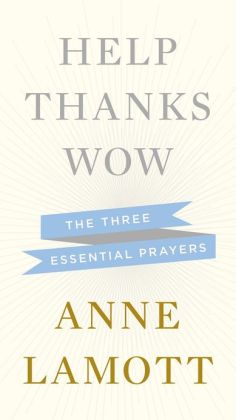
Help. Thanks. Wow.

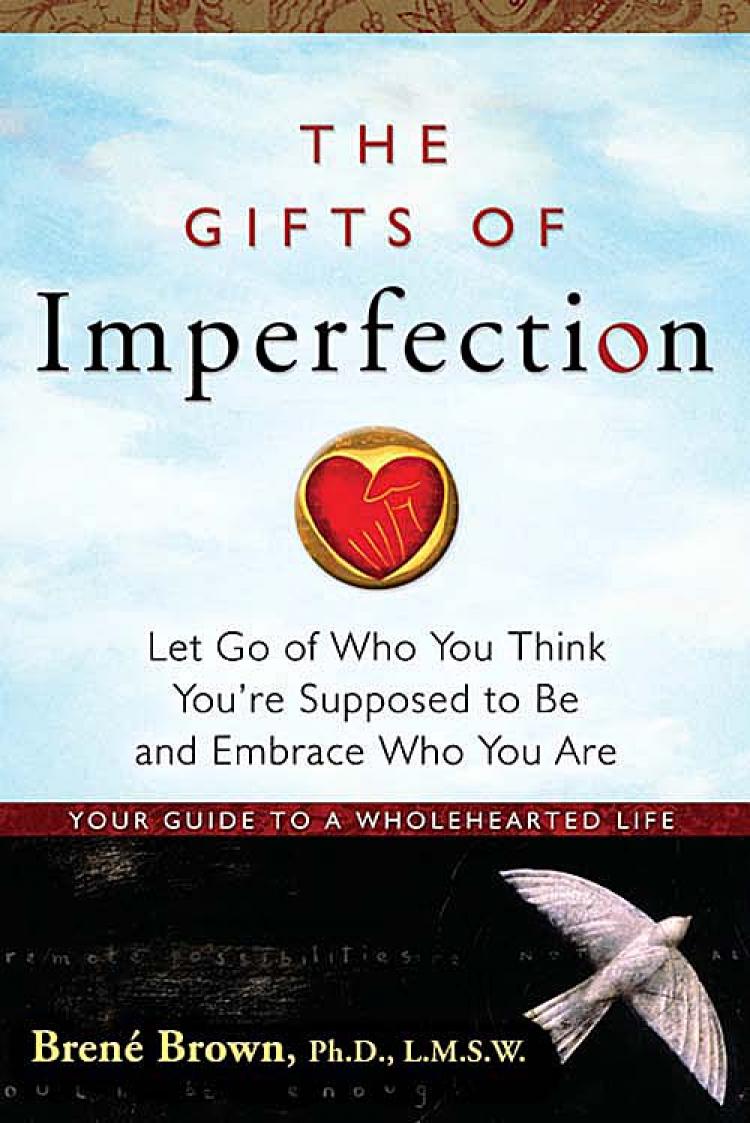
In following with the month of November and trying to lead a life where its richness and depth trumps my to-do lists, and in the same vein as pursuing a life that described in this post about Brene Brown's The Gift of Imperfection, I've been trying to keep a journal for a few minutes each morning for what I am thankful for: the small things like miniature pumpkins and the big ones like my family alike.  

This morning I am thankful for Anne Lamott and also her short book on prayer: Help, Thanks, Wow.  I first read Anne Lamott ten years ago when we had to read her book about writing Bird by Bird for a class.  Randomly afterward I realized I had a handful of friends who were really into her book Travelling Mercies, which is about her faith and was such a refreshing read.  I'm thankful for a writer who can mentor me through a season of wanting to let go of my anxiety and frantic pace.

There are three sections, each dedicated to a word in the title, and she walks the reader through admitting we don't know what to do, the art of gratitude, and the way that wonder can change us and the way we see the world.  I could subtitle this book "breathing deep through all the things," because she describes how these prayer rhythms anchor her as a person able to face life with courage.  It reminded me what a gift centeredness can be.

So I just want to share two excerpts and throw them out into the universe in the hope that someone will connect with them as well, and feel just a little bit more full today:

Without revelation and reframing, life can seem like an endless desert of danger with scratchy sand in your shoes, and yet if we remember or are reminded to pay attention, we find so many sources of hidden water (page 53).  

We're individuals in time and space who are gravely lost, and then miraculously, in art, found...In paintings, music, poetry, architecture, we feel the elusive energy that moves through us and the air and teh ground all the time, that usually disperses and turns chaotic in our busy-ness and distractedness and moodiness.  Artists channel it, corral it, make it visible to the rest of us.  The best works of art are semaphores of our experience, signaling what we didn't know was true but do now (page 82).

Saturday, November 2, 2013

Brene Brown, game changer.

I first heard of Brene Brown last winter when my friend Lindsay told me I had to watch her TED talk called "The Power of Vulnerability." It was a game changer for my emotional health, y'all.  Then Lindsay and I decided we would both read her book The Gifts of Imperfection and it was the perfect follow up for helping me process through what it means to live with meaning and purpose and without anxiety.  Reading the book and reflecting on Brown's research and how it related to my life has been an incredibly powerful experience.  I've slowly and reflectively read this book over the past five months or so. This post is a little vulnerable, but I think Brene Brown would be in favor of me sharing and owning these pieces of my story.

My core spiritual beliefs (grace, love, forgiveness, stillness) have remained much the same over the years, but there came a time when I had to face the fact that from every angle I was hearing: strong people of faith ________.  As a high achieving people pleaser, for many years I ran without stopping in my volunteer work, my actual work, and in the commitments I made in my free time.  Sometimes despite hearing an overarching message of grace and love, I felt as though I was constantly not measuring up to what I was "supposed" to be doing, which was difficult for a perfectionist (though now I consider myself a recovering one) and felt as though I had to be apologetic for my introverted nature.  I've taken the past few years to redefine what a spiritual life looks like for me and to (finally) learn to be ok with the fact that it does need to look like anyone else's.

A lot of authors have mentored me through this journey: Mother Theresa with Come Be My Light, Anne Lamott with Traveling Mercies and Bird by Bird, Joan Didion with The Year of Magical Thinking, Susan Cain with Quiet, Colum McCann with Let the Great World Spin, Eric Metaxes with Bonhoeffer, and of course the poetry and music of Over the Rhine.  What I appreciate about Brene Brown is that her book seemed to pull together all of these literary influences and helped me to redefine and find freedom in what spirituality looks like for me.


In the journey of trying to define what my spiritual life looks like now, it honestly can be easy to simply not think about it, thus avoiding existential dilemmas.  But, the anxiety that so easily creeps in reminded me that being grounded and intentional is life giving and I noticed that not having an intentional grounding in faith, I became less hopeful in general, a bit cranky, and I forgot to look for beauty.  Brown's definition of spirituality piqued my interest because I was (still am) so tired of the minutia of Christian theology:  "By spirituality, I'm not talking about religion or theology, but I am talking about a shared and deeply held belief.  Here's how I define spirituality: Spirituality is recognizing and celebrating that we are all inextricably connected to each other by a power greater than all of us, and that our connection to that power and to one another is grounded in compassion.  Practicing spirituality brings a sense of perspective, meaning, and purpose to our lives" (64).  


When she wrote "It's not about denominations or dogma. Practicing spirituality is what brings healing and creates resilience. For me, spirituality is about connecting with God, and I do that most often through nature, community, and music.  We all have to define spirituality in a way that inspires us,"(74)  I was reminded of the life nature gives me and how washing dishes or walking with music centers me, and how dinner with my husband and great friends grounds and connects me.

One of the messages I have struggled with as a Christian is that "everything happens for a reason," which I simply cannot buy into no matter how many scripture based conversations I have.  This felt really isolating, especially in the early days of this journey.  I have landed in a place of confidence and rest with this issue and others, and reading Brown's book helped give greater clarity to me: "At first I thought faith meant 'there's a reason for everything.'  I personally struggled with that because I'm not comfortable with using God or faith or spirituality to explain tragedy...Here's how I define faith based on research interviews: Faith is a place of mystery, where we find the courage to believe in what we cannot see and the strength to let go of our fear of certainty" (90).  Faith as a beautiful mystery has been one of the most healing perspectives I've run across.  

To close, one of my favorite parts of the book was when Brown discussed the fact that we can change our neurological pathways, something one of my old pastors used to talk about, too.  It is possible to physiologically change our patterns of thinking (google neuroplasticity).  I'm now living in a way where I am trying to incorporate rhythms into my life that help me feel grounded, connected, grateful, and covered in grace.  This is happening for me through reading, taking time to be creative (watercolor and calligraphy lately), cooking, looking for beauty, and  practicing stillness.  It looks different, but feels beautiful.  
Saturday, June 23, 2012

Weights and Glasses: Wise Blood by Flannery O'Connor

I have read some of Flannery O'Connor's short stories before and was anxious to read her first novel, Wise Blood, originally published in 1949.  It is a story of spiritual searching without lyricism.  Her style feels sparse, dark, sometimes comedic and deeply symbolic.  It follows Hazel Motes, who felt he was destined to be a preacher his entire life.   He returns from World War Two disillusioned and haunted by his faith, ultimately preaching on the street and founding The Church of God Without Christ.  Each of the characters he encounters are wrestling with their own demons, either pressing in to find answers like Enoch Emery who claims claims to have innate wise blood to lead him toward his destiny or a father/daughter pair of religious con artists, where the father pretends to be blind.  


O'Connor' s story left me reading an incredible amount of commentary and  I was amazed that every possible religious world view could have a different interpretation on the religious imagery and symbolism and the characters' fates.  This made it difficult to process through in a coherent manner, which I think is part of the point.   In her author's note, published with the second edition, she writes,  "Freedom cannot be conceived simply. It is a mystery and one which a novel, even a comic novel, can only be asked to deepen."  I tried to read this story through this lens, as freedom can be an incredibly nuanced word, especially when applied to one's personal journey.  


What has stuck with me the most in this vein of thought is the fact that ever since Hazel Motes left for the war, and even upon his return, he carried around an old bible and his deceased mother's old glasses.   Part of the beauty of these two objects is the wealth of things they can symbolize, and in turn how those symbols can cause a reader to think about his or her own life.  Does the bible represent a burden that he is carrying or where he can find freedom? Can it be both? How is that played out in one's life? Are the glasses representative of him looking at life through his family's past? Or just the fact that he is seeking something? Or is he blind to certain parts of life?   He returned from the war a different person--and it is interesting to think about how facing that particular reality colored his worldview and his ultimate fate.


Through the lens of seeking freedom, these objects magnify the complexity of it and whether it is possible to completely be free from one's past and the questions haunting one's mind and whether it is possible to rest and simply be when there are so many things  to process through around us.  What I'm appreciating more and more about this book is life's complexity that O'Connor, who was a practicing Catholic, didn't shy away from.  The pat answers I've encountered along the way feel weightless and empty--and perhaps it is the carrying of the weight while intentionally looking and seeking that brings answers and eventual peace. 

Sunday, May 27, 2012

Best nonfiction read, ever.

When I finished reading Maus and Night it was impossible to not feel the cruelty that is possible in humanity deep in my gut. While reading In the Garden of Beasts, I only became more disengaged with politics and their inability to create the kind of change that the world desperately needs.  I'm a micro-thinker by nature, meaning that I'm a believer and participant in small change on a small nature when it comes to making a difference.  I'm thankful for people who have the brains and enthusiasm for policy and law, but am generally overwhelmed when looking at the world's brokenness at such a vast level.  And so, I sit in my classroom and teach my students to be critical thinkers and to hopefully see some magic through reading and writing.  I knew that I needed to read something that would reveal hope to me on a micro level--to remember that amidst the ugly there were people who loved and people who fought for what was right.  Then I remembered a friend had recommended Eric Metaxas's biography of Dietrich Bonhoeffer to me over a year ago and realized there would never be a better time to read it.

Dietrich Bonhoeffer was a German Christian who was a part of the German resistance to Hitler and became involved with multiple assassination attempts, ultimately hanged at a concentration camp two weeks before the end of the war.  It's just over 600 pages and it overtook my reading and thinking life, which partially explains my month long absence from writing about reading on here.  I've never been more engaged in nonfiction and I have never been so captured by the integrity of a single person.  There isn't a way that I can begin to describe all that I took away from reading it, except to say that I can only hope to strive for justice and love the way that he did.  His life is a story of doing what is right, period, and not hiding under the illusion of safety in rules and regulations and inaction.

Tuesday, April 10, 2012

On belief.

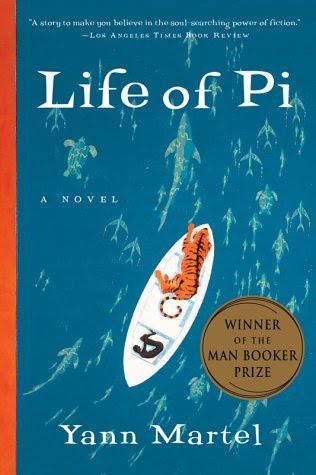
I feel like everything I'm reading lately is asking me to seek out wonder or spend some time in the depths pondering the darker corners of life.  A former student has been begging me to read Life of Pi by Yann Martel for months and I finally did.  Pi is the boy narrator, who is from India and the son of a zookeeper, but most importantly very spiritual.  The beginning of the story chronicles his journey of belief in not only his native Hinduism (though his family wasn't especially religious), Christianity, and Islam.  In response to political is family leaves for Canada on a Japanese ship, which sinks on its journey.  Pi alone ends up in a life boat with a Bengal tiger, zebra and orangutan floating on the ocean for 227 days and is left with his knowledge of zoology and his spirituality.

At the end of the story, Pi recounts his story to two men from Japan seeking answers as to why the ship sank, who don't want anything to do with the story of survival Pi is sharing with them.  Pi then says that he  will tell them an alternate story, in which he substitutes people in for the other animals, like a cook and his mother.  The reader is left to ponder which story is the real story--and in turn if Pi's survival story becomes less meaningful when and if metaphors and substituted for the truth.  This then leads the reader to ponder the nature of truth and faith and story, which is one of the most interesting things I've been asked to think about in a long time and left me wishing, as always, that I had a diverse literature class to discuss it all.

No matter what I think about the ending of the story, though, or Pi's personal theology, I did find that there were a number of moments that spoke into spirituality in a significant way.  When he is speaking with the Japanese men who don't believe him, he says: "If you struggle at mere believability, what are you living for? Isn't love hard to believe?  Love is hard to believe, ask any lover.  Life is hard to believe, ask any scientist.  God is hard to believe, ask any believer. What is your problem with hard to believe?" (page 297).  My mind has been consumed lately with the concept of belief--and I have found myself missing the wonder that often accompanies belief in things beyond sight and frustrated at how difficult belief can be.  Pi, earlier in the book, spoke into this concept.

"Words of divine consciousness: moral exaltation; lasting feelings of elevation, elation, joy; a quickening of the moral sense, which strikes one as more important than an intellectual understanding of things; an alignment of the universe along moral lines, not intellectual ones; a realization that the founding principle of existence is what we call love, which works itself out sometimes not clearly, not cleanly, not immediately, nonetheless ineluctably. 

I pause. What of God's silence? I think it over.  I add: 

An intellect confounded yet trusting sense of presence and of ultimate purpose," (page 63).

This is the condensed version of what I took away from it.  First, I had to look up the word ineluctable.  I'm not ashamed.  Ha. According to the Oxford English dictionary, it means "unable to be resisted or avoided; inescapable."  This makes so much sense to me, because as much as I try to hide from the confusing, unexplainable parts of having faith in something I can't see, it continues to haunt me.  The divine, to me, is indeed ineluctable.  In the book Pi is troubled by God's silence, but he lives in the confounded, rather than hiding from it because of its nature.  This kind of trust is really beautiful to me and reminds me that I don't have to have all of the answers I want right now.  I can live confounded alongside of my belief, too, that "the founding principle of existence is what we call love." 


Saturday, January 21, 2012

in the company of those who struggle.


I came across Mary Karr's book Lit after I read an article in New York Magazine about her, David Foster Wallace, Jeffrey Eugenides, and Jonathan Franzen.  I had read all of the authors except for her and sought out to get a copy of The Liars Club.  Then I found Lit, an incredibly written memoir based in Karr's alcohol abuse, the dissolution of her marriage and recovery, on a brownstone's stoop and decided that would work.   I later found out that a few friends of mine had recently read and loved it, so I moved it to the top of my "to read" stack.

{I've learned that sometimes I love to share the story of how I stumbled upon a story.  Thanks for indulging me.}

There are a few parts from Lit that I haven't stopped thinking about. One was that her recovery and redemption came in the company of those who struggled, too.  Karr found herself in AA with a mix of every kind of person imaginable, none of whom she would have sought out on her own.  The friends she made there were from across the social spectrum, people whose paths would have never crossed otherwise. And yet, they became a lifeline for one another because they deeply understood that struggle is best endured together. No one lives immune to hurt--and that means that each of us has something in common with every person we meet.  

I would not normally call myself a cynic, but in the winter it happens from time to time. For some reason that was the space my mind was inhabiting in the week I was reading this book: not in response to the book, but just in response to life.  I often get frustrated at the instagram-portrayed life.  Don't get me wrong, I think small moments of life's poetry are worth sharing, but sometimes it is easy to start thinking that everyone around has a perfectly curated life.  I know this theory is false.  Or, I start soaking in cynicism about the self promotion social media induces.   I've found that when I remember that I am always in (and a part of) the company of those who struggle, my heart seems to grow in compassion.  

I am always trying to teach my students that books make us better people because we learn to empathize with almost any character once we understand the ins and outs of his or her story.  Sometimes the teacher needs to remember this, too. 

 I also didn't realize just how much spirituality was a part of Karr's journey, and when added to a life rich in real community, a portrait of how beautiful--and simple--life can be rose before me. 

"Therapy rescued me in my twenties by taking me inward, leaching off pockets of poison in my head left over from the past.  But the spiritual lens--even just the nightly gratitude list and going over each day's actions--is starting to rewrite the story of my life in the present, and I begin to feel like somebody snatched out of the fire, salvaged, saved," (304).

I really can't add much to her words, except that by allowing herself to consider, and ultimately accept, the way faith, not religious duty, could change a life, her life and mental landscape began to change.  Sometimes I forget this--and reading Karr's story became one of the brightest reminders of my winter--and my own cold weather induced cynicism and anger has begun to slip away.  

Sunday, November 29, 2009

Advent. Compassion. Or, and they will call him Immanuel.

www.akindoflibrary.blogspot.com

The day the clocks spring forward and the days begin to grow longer, I rejoice.  My ankle length down coat can be packed away and I am free to revel in the spring, summer and fall.  Falling back, however, is not as easy.  I watch the sun sink behind Brooklyn at 4:30.  I have to wear coats and layers and put away my flip flops.  Curses.  I realized that when daylight savings ends, I begin to wait.  For five long, cold, bundled months.  I am not good at it.


Then I remembered today is the first Sunday of Advent, the season of waiting.   One of the best books I read this year that I did not post about was Compassion by Henri Nouwen.  Since I was thinking about it yesterday, I thought I would pick it back up and see what I underlined and it completely changed how I want to be spending the next four weeks of this season:

The virgin shall conceive and give birth to a son and they will call him Immanuel, which means God-is-with-us. Matthew 1:23  "By calling God Immanuel, we recognize God's commitment to live in solidarity with us, to share our joys and pains, to defend and protect us, and to suffer all of life with us."  Nouwen goes on to describe what the definition of compassion means to him: "It is not a bending toward the underprivileged from a privileged position; it is not a reaching out from on high to those who are less fortunate below; it is not a gesture of sympathy or pity for those who fail to make it in the upward pull.  On the contrary, compassion means going directly to those people and places where suffering is most acute and building a home there."

Now I'm trying to figure out how all of these threads fit together, other than the word and thought association led me from one to the next.  I think it is this: I struggle so much with all that is a mess in the world.  I am constantly waiting to see things change.  But, I do not have to despair.  For this liturgical season of waiting, I want to be filled with this kind of compassion.  I want to remember that it is often in the waiting that we are most changed; that in the waiting is when our cup just might overflow.

Saturday, November 28, 2009

Present.

www.akindoflibrary.blogspot.com

Walking into a bookstore is always dangerous for me. I will inevitably find at least five titles I want to read, curse myself for not being able to read faster and choose one that was a serendipitous find...one that I must read, even though the stack of unread books in my apartment is way too high. All that to say (and I fully realize that I am an over-sharer of background information in my story telling) I purchased a hard cover book for the first time maybe ever this fall, I forgot to post about it and it relates to what I had to say about The Age of Innocence. So.

Donald Miller's Blue Like Jazz was published the same year I moved to New York (2003) and came at a perfect time: his thoughts on the Christian faith seemed so refreshing and real, something I desperately needed as I left behind the comforts and sometimes small world setting of southwestern Ohio, despite my deep deep love for it. I hadn't read a book about faith since Henri Nouwen's Compassion last February and honestly didn't really have a desire to. But then I saw Miller's A Million Miles in a Thousand Years newly placed on a shelf, I bought it on impulse and read it in three days.

What drew me to it initially is the entire premise is structured around the concept of story: a character, a character who wants something, a characters who wants something and overcomes conflict to get it. Miller writes about what he learned after he started working with two men who wanted to turn Blue Like Jazz into a movie:

"In a pure story," Steve said like a professor, "there is purpose in every scene, in every line of dialogue. A movie is going somewhere."

"What Steve is trying to say," Ben spoke up, "is that your real life is boring."

It didn't occur to me at the time, but it's obvious now that in creating the fictional Don, I was creating the person I wanted to be, the person worth telling stories about. It never occured to me that I could re-create my own story, my real life story.


I think the reason I was not interested in reading books about faith is because I grew tired of reading books that inevitably added another to do list to my mental check-list: want peace? Here's how to attain it. Want to love people better? Try this out. Want to be a better person? Aye. The mere thought exhausted me and seemed the opposite of what a full life should be: checklists.

What I loved about Miller's book was first was his decision to not live in mediocrity and how he stepped into adventure and beauty. He decided to get up and chase the things that make life meaningful. But, second, he didn't do this out of naivete, thinking one adventure after another would make a great story. He knew heartbreak would most likely abound and struggle would ensue, but that option is so much better than merely watching other people's stories from the comfort of one's couch.

If only Newland Archer had realized this.