Generally, I am a planner. I remember dates. I use a calendar (albeit, I did switch to a digital one, mostly to avoid unnecessary clutter). For summer reading, I always have a plan. Granted, summer reading isn't that unlike my usual reading life, as I always have a book on hand. The only added bonus is more time, thanks to being employed by the NYC Department of Education. Anyway. My book club (read: me and my one friend) got ambitious and we are tackling Infinite Jest by David Foster Wallace this summer. This is an undertaking that I want to take seriously, therefore I am not making a list longer than the following:
Infinite Jest/DFW
Bossypants/Tina Fey
Of course I have other hopes for my summer. Apparently Hamlet is a frequent allusion in Infinite Jest, so I may spend some time with Shakespeare. Or wikipedia. I'm also interested in A Visit from the Goon Squad by Jennifer Egan. I am craving some rereads: Harry Potter and the Deathly Hallows (yes I just read it in the fall. And? The last movie is in July and I intend to make the most of the end of this era), The Summer Book and Anne of Green Gables. Other than that, I will see where the wind takes me. I'm sure there are many of you who are laughing at my planned un-plan. Sigh. It's a start. And the best part is that I'm starting my summer reading plan a month before my official summer starts, so it's like a bonus month!
I am curious: what are your most recent reading loves? I have some time and there is nothing better than a book well-recommended by a friend.
Wednesday, June 1, 2011


Tuesday, May 31, 2011
On leaving. Or, books as escapism.

It is impossible for me to not sink into some kind of melancholia when I leave my family--or especially when they leave me--for I am left with empty spaces and without the distractive hassle of a car ride or air travel that the ability to separate one from emotion more quickly than it decamps the ones who stay in newfound quiet.
My television-less studio apartment was our cramped base camp for multiple nights, a way of life quite different to us who tend to migrate to our own spaces to read or watch a game. And yet it seemed to work. For a weekend, anyway. My thoughts are now lingering on the meal that ended outside this time last night and my makeshift dinner of random leftovers this evening. Without fail, while growing up we came together for family dinner every night from our separate places--work, dance, baseball practice, which have been replaced by Louisville, Cleveland and Brooklyn.
The cool air of evening is impossible to ignore right now as is the fact that dusk can say more with its springtime light and its breeze than I ever could in words--of what it means to long for something. But what I'm longing for now doesn't have a name or a place because it is the memory of my dad calling to say he is on his way home and smell of dinner cooking each night and falling asleep in a full, safe house--the kind of memory that I was too young to be cognizant of while it was happening--combined with the permission to go and pursue and to dream. And I hate how those things--dreaming and being home--feel mutually exclusive right now.
So what else was I to do but sit down and get lost in The Diving Bell and the Butterfly in its entirety tonight? Thoughts to follow.
Monday, May 23, 2011
To my students. With respect. This started as a mentor text on coming of age, but changed along the way. I'm not really sorry for that.
www.akindoflibrary.blogspot.com
Today I made a new bulletin board in my classroom. I realize it is the end of May and that a month from yesterday the students I love will have cleaned out their lockers, left 8th grade behind, looking only toward the season of freedom and their new high schools, which, whether you hated or loved it, is generally smiled upon more than middle school. So. I want the last month in room 116 to matter.
Our unit is called "Reading and Writing Through Coming of Age" and everyone has to read a coming of age novel. Instead of doing book clubs, students can read a book of their choice and we are trying to notice patterns across the genre: what parts of coming of age are universal? What are personal? In the midst of sharing, I hope that students find something that resonates with what life feels like to them right now.
Today everyone had to bring in 2 quotes that spoke into their characters' coming of age experience in the first half of their book and I was blown away by what they found. I've been reading young adult fiction incessantly for the past month (Girl in Translation, Sweet Dates in Basra, The Girl Who Fell From the Sky, Weeping Underwater Looks a Lot Like Laughter, A Northern Light) and though they are all engaging books, I have not been inspired to write off of any of them, or the coming of age experience, which is also the reason behind my severe lack of posts recently. Until today.
I took about 25 of the quotes from 10-15 books that my students are reading and wrote them with permanent black marker on sheets of white paper. I hung them all across the bulletin board that stretches across the entire back wall of my room. All of a sudden it was reverse personification--I saw all of my students somewhere in the paper mess (well, let's be honest, the quotes are hanging orderly, but still) of complicated emotion--and then it became post modern, because I could almost trace their jumps from one quote to another at different times throughout the year. For instance:
"This was simply around the time my parents stopped understanding what I wanted and I stopped understanding what they wanted me to want." (Born Confused)
"Standing there, I loved and hated myself. It made me feel my glory and my shame at the same time." (The Secret Life of Bees)
"You still have a lot of time to make yourself into what you want." (The Outsiders)
"I told the waitress I'd been out all night 'looking for trouble.'" (Teen Angst...Nahh)
"I didn't answer him. I didn't feel like it." (Catcher in the Rye)
And I guess the reason that I wasn't connecting with any of the young adult books I was reading was because I wasn't picturing my students in them, because after listening to them read all their quotations and hearing their voices, I was tapped into their lives--albeit the slivers they allow to come out in English class, but it was as though the beauty of becoming and possibility was present. I'm not sure if they noticed it. But I did. And I'm absolutely sure that they will make fun of me for my waxing poetic about a day in class. But.
This week we talked about the first half--the pain, the confusion, the struggle. Next week we talk about the second half--the resolution, the growth, the wholeness, the strength. I. Love. Story. And I love to think about the people that these favorites are going to become and the stories they are going to be able to tell when they make it to the other side of growing up. But here are a few pictures of who they are right now. They are kind of endearing, right? You can read their writing at www.room116ela.blogspot.com.
Today I made a new bulletin board in my classroom. I realize it is the end of May and that a month from yesterday the students I love will have cleaned out their lockers, left 8th grade behind, looking only toward the season of freedom and their new high schools, which, whether you hated or loved it, is generally smiled upon more than middle school. So. I want the last month in room 116 to matter.
Our unit is called "Reading and Writing Through Coming of Age" and everyone has to read a coming of age novel. Instead of doing book clubs, students can read a book of their choice and we are trying to notice patterns across the genre: what parts of coming of age are universal? What are personal? In the midst of sharing, I hope that students find something that resonates with what life feels like to them right now.
Today everyone had to bring in 2 quotes that spoke into their characters' coming of age experience in the first half of their book and I was blown away by what they found. I've been reading young adult fiction incessantly for the past month (Girl in Translation, Sweet Dates in Basra, The Girl Who Fell From the Sky, Weeping Underwater Looks a Lot Like Laughter, A Northern Light) and though they are all engaging books, I have not been inspired to write off of any of them, or the coming of age experience, which is also the reason behind my severe lack of posts recently. Until today.
I took about 25 of the quotes from 10-15 books that my students are reading and wrote them with permanent black marker on sheets of white paper. I hung them all across the bulletin board that stretches across the entire back wall of my room. All of a sudden it was reverse personification--I saw all of my students somewhere in the paper mess (well, let's be honest, the quotes are hanging orderly, but still) of complicated emotion--and then it became post modern, because I could almost trace their jumps from one quote to another at different times throughout the year. For instance:
"This was simply around the time my parents stopped understanding what I wanted and I stopped understanding what they wanted me to want." (Born Confused)
"Standing there, I loved and hated myself. It made me feel my glory and my shame at the same time." (The Secret Life of Bees)
"You still have a lot of time to make yourself into what you want." (The Outsiders)
"I told the waitress I'd been out all night 'looking for trouble.'" (Teen Angst...Nahh)
"I didn't answer him. I didn't feel like it." (Catcher in the Rye)
And I guess the reason that I wasn't connecting with any of the young adult books I was reading was because I wasn't picturing my students in them, because after listening to them read all their quotations and hearing their voices, I was tapped into their lives--albeit the slivers they allow to come out in English class, but it was as though the beauty of becoming and possibility was present. I'm not sure if they noticed it. But I did. And I'm absolutely sure that they will make fun of me for my waxing poetic about a day in class. But.
This week we talked about the first half--the pain, the confusion, the struggle. Next week we talk about the second half--the resolution, the growth, the wholeness, the strength. I. Love. Story. And I love to think about the people that these favorites are going to become and the stories they are going to be able to tell when they make it to the other side of growing up. But here are a few pictures of who they are right now. They are kind of endearing, right? You can read their writing at www.room116ela.blogspot.com.
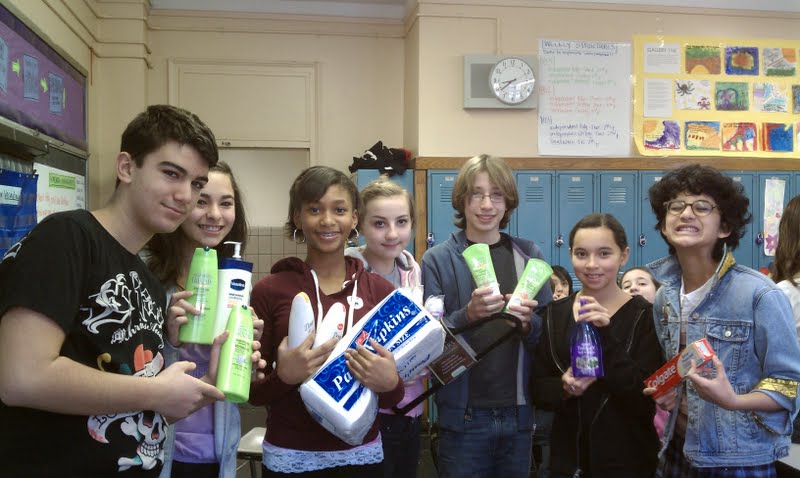 |
| My "Sold" bookclub with supplies they bought for Restore NYC's safehouse. |
 |
| Mustache Monday. Obviously. |
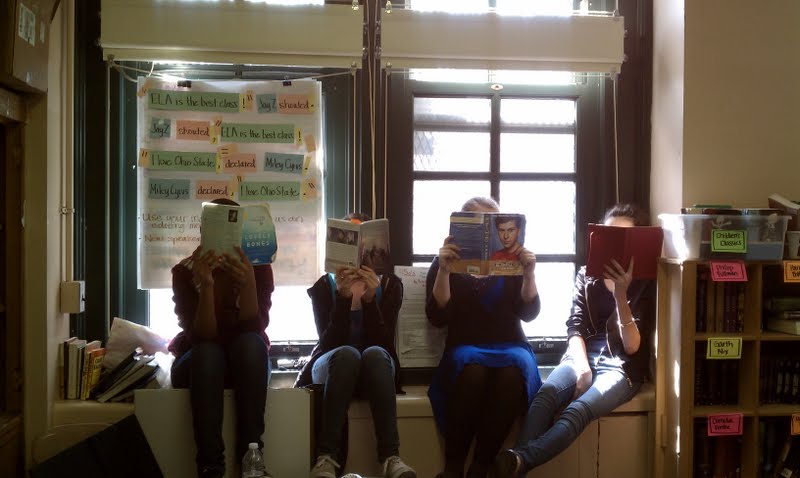 |
| We take reading seriously. |
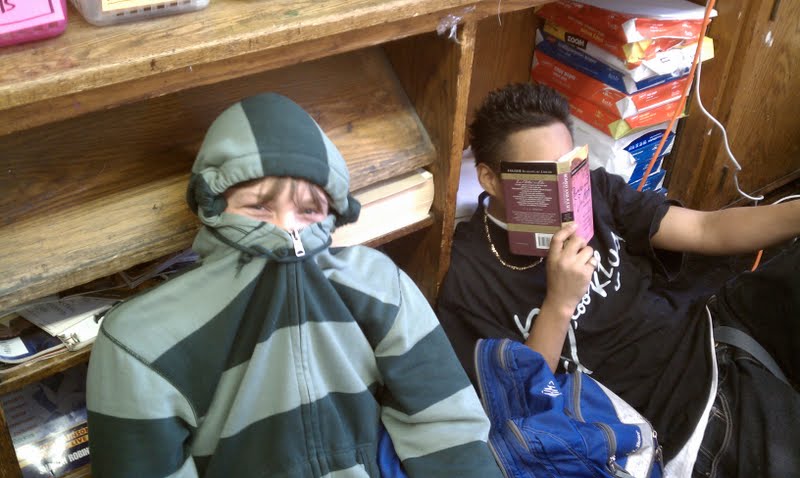 |
| Like I said, seriously. |
 |
| My homeroom gets so excited to come back after lunch. Ha. |
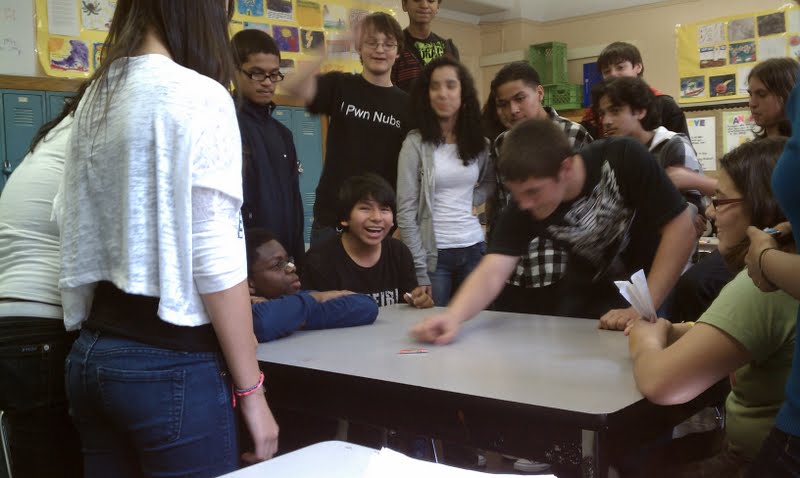 |
| Sometimes we play paper football. |
 |
| There aren't words for just how great this one is. Or how amazed I was to capture the single second that they weren't hysterically laughing after decorating my board so thoughtfully. |
Sunday, May 22, 2011
The Pain of Beloved.

"Can't nothing heal without pain, you know," (92).
These quotes stayed with me throughout reading Beloved by Toni Morrison because at its core, it is a book about existential hurt, impossible choices and living with their ghosts and yet, it is about moving forward--and the story itself feels like a way to let the hauntings go.
I finished the book weeks ago and am still thinking about what a powerful, important, disturbing read it was. The plot centers around a former slave named Sethe who escapes to Cincinnati where her children are already living, giving birth to her fourth child along the way. Less than a year after her and her childrens' escape , she is in the backyard of the house she shares with her mother in law and sees a man from the plantation where she spent her life ready to call upon the Fugitive Slave Act. Sethe chooses to gather her four children and attempts to kill them, rather than allowing them to be brought back into slavery. Three of the four are spared. The bulk of the story is set over a decade later when her house is haunted by the child's ghost. Two people arrive: Paul D, a man who was also a slave on the plantation with Sethe, with whom she begins a relationship. For a time, he is able to scare the ghost away, but then a girl arrives who Sethe and her daughter Denver believe to be the incarnated ghost, which completely rocks and changes Sethe, forcing her to face her past decisions. The book is about the spiral of Sethe wrestling with her demons and the definition of love, of finding and losing herself.As a reader, I couldn't discern if the ghost-girl was literal or figurative--and at different moments I think could be either. So I've been thinking about the questions Beloved poses in terms of healing: on both a personal and corporate level. It is much too heavy of a story to simply say that it ends with hope--it is a beautiful mess of a narrative that left me a wreck while reading it.
Sethe's turmoil through Morrison's writing feels weighty enough to be corporate. It is not just her story, it is the story of the psychological effects of slavery. On this level, I felt as though I had no place to judge Sethe for her choices--and how she chose to define the love she had for her children. Sethe writhes with her choice and it is impossible as a reader not to do so right along with her. It feels an impossible situation, where I can't decide if the healing of an entire nation after such an abomination on humanity or the healing of a single heart engulfed it it feels more difficult.
This is when I come back to the quotes I cited at the beginning, that came in the first third of the story and were spoken to Paul D, but shaped what I began to see as the purpose of the whole book: that Sethe had to wrestle with the pain and had to feel it deeply. There was no way to move forward without it. Paul D says to Sethe toward at the end, when Sethe is still is the ashes of her life: "me and you, we got more yesterday than anybody. We need some kind of tomorrow." This seems so simple and almost trite, but only out of context. The poetry and pain of this story--individual pain of the characters and the pain of looking at our history of a nation-- echo for anyone who has felt the complicated brokenness of tragedy and the reluctance to even try to heal. What Morrison leaves the reader with is the idea that there is still life. There is still life.
Friday, April 29, 2011
The length of an hour. Or, hope, and finding it even when it feels far away..
 www.akindoflibrary.blogspot.com
(A note: Reading The Hours after Mrs. Dalloway was incredible. The research and allusion that went into Cunningham's book is tremendous, though it is incredibly thought provoking on its own as well.)
The Hours haunted me for days after reading it--mainly two of the ideas that Cunningham explores. First, each choice a person makes leaves a trail of missed opportunities behind him or her--lives that weren't lived. Almost all of the characters in Mrs. Dalloway consider the decisions they made--and what Cunningham does in his book is give those alternate stories life. It is through the alternate stories that the reader must face some inevitable truths.
For instance, in Mrs. Dalloway, Clarissa, feeling dissatisfied, daydreams about what life might have looked like if she had been able to choose her best friend Sally as a life partner instead of her husband Richard. In The Hours, we see that desire played out as the character of Clarissa is a modern woman in her fifties in New York City living with her partner of 18 years, Sally. Cunningham creates other nuances that continue the conversation Woolf started 77 years before--but there is meaning behind this even to people who haven't read either book: even when the characters are given the cultural freedom to pursue what they want, no one feels completely satisfied. In both novels, the characters tell themselves stories and imagine different lives for themselves to cope with the reality they are actually faced with.
It is easy to look back on missed opportunities poetically, imagining the happiness that might have been. But such is the illusion of fantasy: we are stuck in the real world with flawed people and to not address this is to not be honest with oneself. Such truth is burdensome to the reader throughout the entire book, whether it be in small, internal conflicts of the characters or tragic ends.
What seems to bridge that concept to any kind of hope at all, is Cunningham's address of hours themselves--not all hours carry the weight or are even the same symbolical length.
Richard, who is dying of AIDS, says: "But there are still the hours, aren't there? One and then another, and you get through that one and then, my god, there's another. I'm so sick." As Clarissa is processing Richard's illness, remembering their summer-long relationship, perfect in each of their memories, as well as her current anxiety, she finds: "There's just this for consolation: an hour here or there when our lives seem, against all odds and expectations, to burst open and give us everything we've ever imagined, though everyone but children (and perhaps even they) knows these hours will inevitably be followed by others, far darker and more difficult. Still, we cherish the city, the morning; we hope, more than anything, for more."
It is the small moments we wish we could have frozen in time that keep us moving forward--and become long as they are played over and over again in our minds, and the long monotonous hours that make us human...and I think, I think remind us that we are not made for a world with such brokenness because even if we make all the right choices, the longing remains. And that is when we, when I, must run for my life to hear a pedal steel and a banjo, or chase an urban sunset for good measure and a good reminding that there is abundant life to be had.
Tuesday, April 12, 2011
"Loneliness brings the best out of a reader."
www.akindoflibrary.blogspot.com
I heard this wisdom today from a student. You can read more from Audrey Bachman HERE. You won't regret it.
I heard this wisdom today from a student. You can read more from Audrey Bachman HERE. You won't regret it.
Monday, April 11, 2011
... from The Hours by Michael Cunningham and suited for conversation, I think. I need to store them somewhere, though. and write about them someday, after I've talked to you. or, more reasons why story matters, because how else do you say it?
Clarissa wants, suddenly, to show her whole life to Louis. She wants to tumble it out onto the floor at Louis' feet, all the vivid, pointless moments that can't be told as stories. She wants to sit with Louis and sift through it. (page 132)
There is still that singular perfection, and it's perfect in part because it seemed, at the time, so clearly to promise more. Now she knows: That was the moment, right then. There has been no other. (page 98)
Still, there is this sense of missed opportunity. Maybe there is nothing, ever, that can equal the recollection of having been young together. Maybe it's as simple as that. (page 97)
She has not spoken on his behalf but on Leonard's, in much the way her own mother might have made light of a servant's blunder during dinner, declaring for the sake of her husband and all others present that the shattered tureen portended nothing; that the circle of love and forbearance could not be broken; that all were safe. (page 74)
There is still that singular perfection, and it's perfect in part because it seemed, at the time, so clearly to promise more. Now she knows: That was the moment, right then. There has been no other. (page 98)
Still, there is this sense of missed opportunity. Maybe there is nothing, ever, that can equal the recollection of having been young together. Maybe it's as simple as that. (page 97)
She has not spoken on his behalf but on Leonard's, in much the way her own mother might have made light of a servant's blunder during dinner, declaring for the sake of her husband and all others present that the shattered tureen portended nothing; that the circle of love and forbearance could not be broken; that all were safe. (page 74)
Subscribe to:
Posts (Atom)