Saturday, November 2, 2013

Brene Brown, game changer.

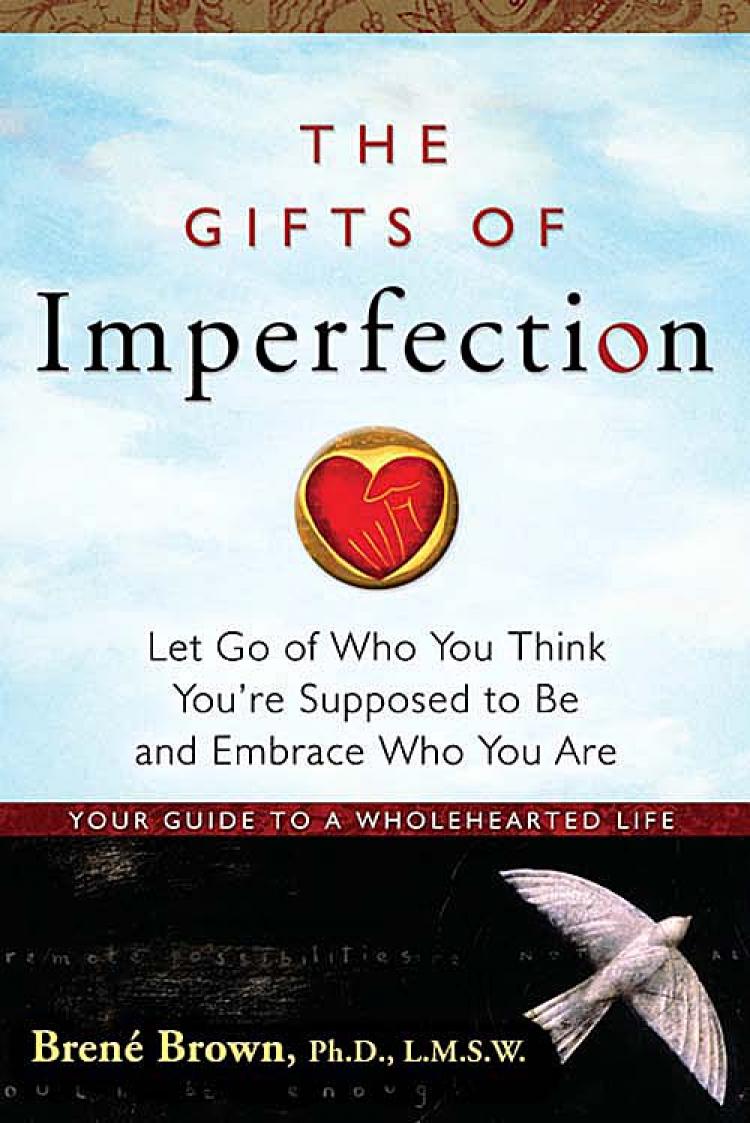
I first heard of Brene Brown last winter when my friend Lindsay told me I had to watch her TED talk called "The Power of Vulnerability." It was a game changer for my emotional health, y'all.  Then Lindsay and I decided we would both read her book The Gifts of Imperfection and it was the perfect follow up for helping me process through what it means to live with meaning and purpose and without anxiety.  Reading the book and reflecting on Brown's research and how it related to my life has been an incredibly powerful experience.  I've slowly and reflectively read this book over the past five months or so. This post is a little vulnerable, but I think Brene Brown would be in favor of me sharing and owning these pieces of my story.

My core spiritual beliefs (grace, love, forgiveness, stillness) have remained much the same over the years, but there came a time when I had to face the fact that from every angle I was hearing: strong people of faith ________.  As a high achieving people pleaser, for many years I ran without stopping in my volunteer work, my actual work, and in the commitments I made in my free time.  Sometimes despite hearing an overarching message of grace and love, I felt as though I was constantly not measuring up to what I was "supposed" to be doing, which was difficult for a perfectionist (though now I consider myself a recovering one) and felt as though I had to be apologetic for my introverted nature.  I've taken the past few years to redefine what a spiritual life looks like for me and to (finally) learn to be ok with the fact that it does need to look like anyone else's.

A lot of authors have mentored me through this journey: Mother Theresa with Come Be My Light, Anne Lamott with Traveling Mercies and Bird by Bird, Joan Didion with The Year of Magical Thinking, Susan Cain with Quiet, Colum McCann with Let the Great World Spin, Eric Metaxes with Bonhoeffer, and of course the poetry and music of Over the Rhine.  What I appreciate about Brene Brown is that her book seemed to pull together all of these literary influences and helped me to redefine and find freedom in what spirituality looks like for me.


In the journey of trying to define what my spiritual life looks like now, it honestly can be easy to simply not think about it, thus avoiding existential dilemmas.  But, the anxiety that so easily creeps in reminded me that being grounded and intentional is life giving and I noticed that not having an intentional grounding in faith, I became less hopeful in general, a bit cranky, and I forgot to look for beauty.  Brown's definition of spirituality piqued my interest because I was (still am) so tired of the minutia of Christian theology:  "By spirituality, I'm not talking about religion or theology, but I am talking about a shared and deeply held belief.  Here's how I define spirituality: Spirituality is recognizing and celebrating that we are all inextricably connected to each other by a power greater than all of us, and that our connection to that power and to one another is grounded in compassion.  Practicing spirituality brings a sense of perspective, meaning, and purpose to our lives" (64).  


When she wrote "It's not about denominations or dogma. Practicing spirituality is what brings healing and creates resilience. For me, spirituality is about connecting with God, and I do that most often through nature, community, and music.  We all have to define spirituality in a way that inspires us,"(74)  I was reminded of the life nature gives me and how washing dishes or walking with music centers me, and how dinner with my husband and great friends grounds and connects me.

One of the messages I have struggled with as a Christian is that "everything happens for a reason," which I simply cannot buy into no matter how many scripture based conversations I have.  This felt really isolating, especially in the early days of this journey.  I have landed in a place of confidence and rest with this issue and others, and reading Brown's book helped give greater clarity to me: "At first I thought faith meant 'there's a reason for everything.'  I personally struggled with that because I'm not comfortable with using God or faith or spirituality to explain tragedy...Here's how I define faith based on research interviews: Faith is a place of mystery, where we find the courage to believe in what we cannot see and the strength to let go of our fear of certainty" (90).  Faith as a beautiful mystery has been one of the most healing perspectives I've run across.  

To close, one of my favorite parts of the book was when Brown discussed the fact that we can change our neurological pathways, something one of my old pastors used to talk about, too.  It is possible to physiologically change our patterns of thinking (google neuroplasticity).  I'm now living in a way where I am trying to incorporate rhythms into my life that help me feel grounded, connected, grateful, and covered in grace.  This is happening for me through reading, taking time to be creative (watercolor and calligraphy lately), cooking, looking for beauty, and  practicing stillness.  It looks different, but feels beautiful.  

Saturday, October 19, 2013

Literature and Loss: Wave

I am currently taking an elective for graduate school called Death Education.  It sounds off-putting and dark, but was described for me as a class that every teacher should take.  It also meets for two weekends, so with those two endorsements, instead of trekking up to Teachers College once a week from Brooklyn, I decided to enroll.  One of the first topics we discussed together was the emotional impact of loss of any kind: from an object to moving, divorce to faith, confidence to health and of course the death of loved ones.

There is freedom in the angle with which we approach our research assignments and projects, so I am approaching the topic through the lens of what I do: an English teacher.  My thinking has been mostly applied to the treatment of death in young adult literature and the impact it has on its readers and my conclusion has been that young adults need to have access to books by trusted authors about death and loss because not only do they teach so much about life and loss.  Books I've referenced with my students are ones like Bridge to Terabithia, A Monster Calls, Counting by Sevens and the Harry Potter series. Revisiting these titles has taught me so much about grief and emotional endurance and survival, especially as we are dealing with the tragic loss of one of their classmates.

Meanwhile, I just finished reading the highly acclaimed memoir by Sonali Deraniyagala, Wave, which chronicles her story of grief after losing her two sons, husband, and both parents in the 2004 tsunami in Sri Lanka.  It is a story of such weight that I feel inept to say anything except I find it important to read and understand the stories of individuals alongside the over arching stories of the tsunami as a whole. In the same way that the young adult literature I have studied provides resources for my students, this book walks its reader through loss at its most intense--and rather than feeling like a voyeur of someone else's hurt, it caused me to connect deeply with what it means to be human and I'm deeply grateful for  Deraniyagala's strength to share this story with us.  It was as significant a read to me as Joan Didion's Year of Magical Thinking.

At this point, all I can say is I'm thankful.

I am thankful to authors who courageously write through their experience and share it so readers can be changed by their examination and process. I am thankful to authors whose writing enables me to understand humanity: my own and that of each of the living souls around me.  I am thankful to authors who write about the hardest things so I can glean some of their courage when I face them myself.  I am thankful to story and its ability to help us heal.

Monday, October 14, 2013

More Than This

 I read (and wept through) A Monster Calls by Patrick Ness this summer, about a boy processing that his mother isn't going to survive her cancer.  When I saw he had a new title out, I was quick to pick it up and I can confidently say I've never read a book like More Than This: it straddles science fiction and mystery while having 3 beautifully written, realistic characters.  Interestingly, it also deals with death: the first chapter starts with the narrator, Seth, drowning in the ocean near his home.  From there, he wakes up in some kind of afterlife, which he spends the length of the book trying to figure out while simultaneously facing some of the hardest, most difficult, as well as the most poignant moments of his prior life, covering namely loss, parent/child relationships, teenage friendship, identity, and first love.

To write too much about the plot and this afterlife of Ness's creation would be to ruin the experience of reading the book (which I highly recommend), so I'm going to focus on a few of the life philosophies of some of the characters.  Ness weaves these philosophies not so much for the reader to choose one, but for the reader to become aware of some of the many complex ways people use to make their way through life, as Seth faces both his current life and what he finds as both of his former lives and attempts to cull meaning from each of them.

The hopeful. Seth's friend and first love Gudman says multiple times throughout the book in Seth's memory: "There's always beauty if you know where to look."  This phrase haunts Seth in his deepest moments of pain.

The seeker of meaning and the cynic.  Seth spends much of his time in the afterlife trying to figure out a greater narrative for what is happening to him.  Regine, one of the two people he meets there says: "People see stories everywhere...That's what my father used to say.  We take random events and we put them together in a pattern so we can comfort ourselves with a story, no matter how much it obviously isn't true.  We have to lie to ourselves to live.  Otherwise we'd go crazy."

The escapists. When his parents are considering a scientific, virtual escape from their lives after a tragedy Seth father shares: "You mean Lethe. The river of forgetfulness in Hades.  So the dead don't remember their former lives and spend eternity mourning them."  

This brings us back to the title--there must be More Than This.  There are parts of life that seem to make no sense and we must seek to find answers.  We must know the present reality isn't always the only truth. Ness seems to be saying the answer doesn't lie within a singular philosophy, but in a complex matrix.  The older I've gotten, the more I appreciate openness to mystery and the more I've started accepting living in uncertainty.  That doesn't mean I don't have some anchors set down in a few key places, just that this life is so much bigger than I ever imagined.  

Sunday, October 6, 2013

The Age of Miracles & maintaining a sense of self


Months ago I saw the book The Age of Miracles by Karen Thompson Walkder and added it to books I wanted to read, namely because it sounded like a good next step for my 8th graders who had read every futuristic, dystopian novel in the young adult section and were ready for an adult level book.  I ran into it the while browsing in the digital books collection of the Brooklyn Public Library and decided it should be my first library ebook.

The premise of the story is that one seemingly typical morning, people wake up to a news story that states the rotation of the earth has shifted and minutes have been added onto the day.  This continues and throws the entire world into a frenzy as the governments decide to remain on 24 hour clock-time which, as the days grow longer, can mean the waking "day" is completely in the dark and the sun is shining brightly while people are sleeping at "night."  Of course there are people who decide to rebel and let their circadian rhythms readjust, but soon the days become 48 hours long.  Some people become afflicted with sickness, tides are shifted way off and coasts flood, the magnetic field is damaged and the sun's rays become so dangerous that people do not walk into the sun anymore.

What I kept thinking about was that even though there were life changing and life threatening conflicts, people needed to maintain a sense of self in the face of it all--and that may be what enables them to face the conflicts with courage. This made me start thinking about when everything in life feels like it is being thrown off--when the earth's rotation in this story is like a metaphor for our lives--how do we cope? 

I've been thinking a lot lately about the importance of taking the time to do the things that are good for my soul--even if that means not finishing everything on my to do list.  Or even if it means deciding to paint or bake instead of sitting in front of another crime show--which feels relaxing for the moment, but doesn't impact my sense of well being in the long run. 

What was devastating in the book was when the government decided to make a time capsule of sorts so that if civilization were destroyed, people of the future would have an understanding of the age.  Inside the capsule, though, was a disc that contained information about how civilization worked: the internet, government systems, medical advances.  Our narrator, who is telling the story from her mid twenties about her 12 year old self said: "Not mentioned on the disc was the smell of cut grass in high summer, the taste of oranges on our lips, the way sand felt beneath our bare feet, or our definitions of love and friendship, our worries and our dreams, our mercies and our kindnesses and our lies," (267).  These are the things of actual life.  The things that she shares throughout the length of the book itself.  And that, is a beautiful and clever idea from the author: it is the stuff of stories that make life worth living.  (It reminded me a lot of this book, which I also wrote about here.)

And so, I've tried to be in pursuit of these things that remind me of the goodness of life; the things that store up strength for later and can provide true comfort.  For me, that has meant art and cooking real meals and going for runs in Prospect Park to soak in the season.  Having these rhythms in place keeps me grounded when life seems to throw everything else off.  And that in and of itself, constitutes a miracle.  

Sunday, September 15, 2013

Feeling September-ish. Or, how Over the Rhine reinvigorated my life last weekend.

This post switched directions a number of times as I wrote it this morning.  There are just a lot of big ideas swirling in my brain this week about music and art and words.  The short version is that music and lyrics breathe life into us.  If you want to take the long way around, read on.

Perfection, to me, often involves traveling with the right kind of music.  In college, I drove on State Route 73 in southwest Ohio at least three times a week.  Most of the time it was early evening when the light softens or at night--and out there you can see so many stars because Oxford, Ohio is surrounded by farmland.  Since I was in Oxford from September-May, these drives often were accompanied by open windows and the heat on my feet.  And of course, the right kind of playlist.  My car became a sanctuary of sorts that allowed me to have time and space to think by myself and my music--the 5 inch binder of CD options--was what spoke to me.  I'm realizing looking back just how important those moments of listening to music and lyrics was to my mental and emotional health.  Those were the days when music like Over The Rhine and Ryan Adams and Patty Griffin were brand new to me.  I heard Bela Fleck's Big Country for the first time.  The Dixie Chicks threw some attitude into my country music and Nickel Creek pulled me into bluegrass.

Since moving to New York ten years ago, my rhythms with music have changed considerably, mostly because one can't take the subway and look out on farmland at the same time.  Ten falls ago I walked with my tea to the Hudson River at Riverside Park seeking healing from homesickness and took the music that felt like home, namely the OTR's Ohio album.  When I moved downtown my river walks and runs changed me along with Iron and Wine and Sufjan Stevens and of course Drunkard's Prayer.  When I moved to Brooklyn, I commuted by foot and rotated The Head and the Heart, Fleet Foxes, Alicia Keys, Miranda Lambert through the streets of my neighborhood, along with a heavy dose of The Long Surrender.

Last March I moved out of the apartment I lived in by myself into one a stone's throw from work. It took me five months to realize that music wasn't playing in the way it once was.  Luckily, this realization came right before a new school year started, and therefore is helping to set the tone for this new season of my life.  September is essentially my new years, after all.  I was lucky enough to escape to Cape Cod during the four days before school started and poetically, Over the Rhine just released their latest album. I knew that to appreciate it fully I needed to hear it not just while doing dishes in my apartment, but away from the city.  I had just read an article about their writing process and learned that my life-line song on their last album was inspired by one of my favorite poets, Adam Zagajewski.  I also read how one of the new songs was inspired by Anne Lamott.  It all seemed too perfect a way to start a new year of teaching reading and writing--and to be reflective and writerly along the way.


So, I was with kindred music listeners.   We put it on as soon as we got past anything that felt like city life, and my ability to breathe deeply coincided with Karin Berquist's voice and Linford Detweiler's piano and the rapid increase in trees outside my window.  That was when I was reminded of driving on 73 in my home state--where the music and the lyrics hit you right where they need to and your lungs can fill with air again.

So all weekend, on near empty beaches, with coffee and Bailey's, and in a hooded sweatshirt I listened to Meet Me At the Edge of the World and felt whole and at home.

Monday, September 2, 2013

Summer Reading Conclusion

I write about it every year, but never have I been more grateful for the rhythm of summer to work its wonders in my overwhelmed teacher brain.  This year in particular I was able to be re-inspired and energized professionally by the Teachers College Reading and Writing Institutes in July, take a few weeks to read, breathe and finalize details for my wedding, then celebrate getting to spend the rest of my life with the best guy I'll ever know with my favorite people in the world.  We were able to escape and soak in the Cinque Terre, Florence, and Barcelona.  And suddenly I found myself excited to be thinking about September, my new students, and who we will all be as readers and writers.   Here's the text journey that got me to this place. I posted in mid June about my plans, which included curling up with some nonfiction, but that never happened.  I think in the summer, especially, I just want to get lost in a good story.  I've starred the ones that I'd most highly recommend.

I call these books the "I commuted for over two hours every day" collection from late June/early July.  You can also tell by the fact that I blogged extensively in my early summer days that I was ready to really think about what I was reading.

Z: A Novel of Zelda Fitzgerald by Therese Anne Fowler
The Interestings by Meg Wolitzer
The Unbearable Lightness of Being by Milan Kundera
The Ocean at the End of the Lane by Neil Gaiman**
My Brilliant Friend by Elena Ferrante
The Illusion of Separateness by Simon Van Booy**

These books are the "I need a vacation and only want to read mysteries" collection from August.  You can tell by the lack of blog posts about these books that I was either on vacation or starting to plan curriculum, so I haven't written about these yet. The first three I read on my Kindle--as a e-book newbie.

Life after Life by Kate Atkinson**
The Stone Cutter by Camilla Lackburg
The Cuckoo's Calling by Robert Galbraith (J.K. Rowling)
Where'd You Go Bernadette? by Maria Semple

Young Adult:
A Monster Calls by Patrick Ness**
I am J by Cris Beam
Playground by 50 Cent
Nothing to Fear by Jackie French Koller

On my parents' porch, as always, I read The Summer Book by Tove Jansson.  However, I didn't write about it this year because this was in the three days before my wedding. I did post about it on instagram, though! A picture is a text, too, you know:)

Happy September.  Enjoy the new starts, the school supplies, the football, the pumpkin spice.  Sigh.

Sunday, September 1, 2013

Reflections on my first month of E-Reading

If you were to walk into my apartment, you would find three industrial sized shelves filled with books that we were certain would be ample space for a growing library, but were filled to the brim by the time we were done unpacking.  My piles of books have grown to the coffee table, living room floor, and of course my nightstand.  I'm old fashioned in that not only do I love the smell of paper books, old and new, I also think that stacks of beloved books are one of the best ways to decorate a home.  My old studio apartment didn't have room for shelves, so they were stacked into piles all around the periphery and somehow that worked, too.

So you'd understand how strange it was as I got more involved in education conversations about technology in the classroom and the tug I began to feel that I needed to (gah!) give the whole e-reading thing a shot.  I knew I'd be traveling for most of August, ten days of which internationally.  The last time I traveled for more than a week my books took up more space in my carry-on than my clothes, so I decided that summer travel would be the best time to start AND be excited about e-books.  (My chiropractor is also excited because he would shake his head every time he saw me reading a crazy heavy book that I'd lugged all over the city.)  I bought a kindle.  I downloaded the kindle app on my iphone.  I also got an ipad mini somewhere in the mix. Off I went.  Here's what I learned:

  • It was difficult to get used to the buttons on the kindle.  I kept thinking the one on the right should be forward and on the left should be backward.  That is not the case, which took me the length of my entire first book to master.  I'm getting old. 
  • The kind of book I'm reading seems to matter.  While in a more "literary" book, I am much more apt to want to go back and reread certain parts or backtrack a bit to draw connections, etc.  While reading Kate Atkinson's Life After Life, I repeatedly wanted to go back to earlier parts due to the structure and nature of the story, but it was really cumbersome so I mostly gave up.  (Maybe this will help my memory? Rewire some parts of my brain as I try to hold onto more details?)  However, this wasn't an issue at all while reading Camilla Lackburg's thriller The Stonecutter.  
  • Taking notes is now both easier and harder.  By nature I don't like clutter, so I've been happy to embrace the "notebook" app on my iphone for shopping lists and using pinterest instead of pulling out sheets from magazines.  It was hard for me to not be able to actually underline.  I'm working on digital underlining and note taking.  I think I'll get there.  My kindle isn't a touch screen, so that was another interesting aspect of the kind of technology I've grown accustomed to using. 
  • While traveling, my carry on bag and suitcase were so much lighter.  I kind of didn't know what to do with myself at the airport.   However, I needed a backup to occupy my mind until all electronic devices were cleared! My husband made fun of me that I couldn't just sit--but I'm sure there are other crazies who don't want to lose a half an hour of solid reading time! Luckily I had my most recent New York Magazine in my purse as well.  Maybe one day I'll be able to just sit and think on a plane. Or the subway. Or in line.  
  • I love the ipad app for one of my favorite cookbooks:  Mark Bittman's How to Cook Everything.  LOVE.  Also, I am into the magazine apps for ones I subscribe to like Bon Appetit and New York Magazine.  That was a surprise. 
  • E-reading gave me a lot of insight into my job: I was aware of my own "moves" as a reader and I began to see how some traditional teaching methods--like annotating and using post its--might not be applicable to all of my students anymore.  Trying out note taking strategies on my devices was definitely helpful as my students become increasingly more digital and less analog.  I'm dreaming about loading up kindles with series books for students and having them available for checkout.  I found out that the Brooklyn Public library has a huge selection of ebooks of all kinds using the Overdrive app for devices.  These are game changing developments for classrooms like mine where I'm dying to get more books in front of my students.  (Next up: getting out of the dark ages in NYC schools and starting a "Bring Your Own Device" policy!) The implications of knowing your "stats" automatically without an annoying (thought educationally helpful) reading log seems genius!
  • It's really easy to get a book, which is good and bad.  One of my friends said that she reads so much more because it's so easy to get books to read from home--and studies back up that notion: convenience makes more avid readers.  One of my favorite things to do is to browse in a bookstore and that is generally how my (digital-ha) list of books to read grows.  As convenient as e-readers are, I passionately support independent booksellers and this is a palpable tension because I try to go out of my way to purchase books from them and only go to the megastores if I'm in a pink or can't find what I'm looking for. But, to close this post, I'll share my recent find on my e-reading journey: 

This posting from Galleycat helped me find ways I can still support independent stores and enjoy the convenience of not having a 15 pound purse.  I'll let you peruse at your leisure, but the bottom line is that there are a lot of independent stores now selling ebooks on their websites.  Not all, but I can still support some of my local favorites like Greenlight Bookstore.

I'll be sure to share more on my e-reading experience, but I'm most enjoying it due to my lightened load and the way it's making me think about my students' experiences and engagements.  I still love curling up with an actual book and I still have science fiction nightmares a la the paperless world Super Sad True Love Story, and percentages will never be as satisfying as holding 3/4 of a book in my left hand, but I'm going to keep at it for now.