Saturday, February 25, 2012

the perfect vacation read for a lover of books.

New York City Schools take a February break the week of President's Day.  Obviously, this is a huge perk of my job.  I didn't plan anything, really, for the week and it turned out perfectly: hiking upstate twice (once by train, once by car, both poetic in their own ways) with great, old friends, pancakes at Maggie's Krooked Cafe (the best pancakes in the world that I usually only get once a year in the fall), an amazing driving soundtrack, baking a Guinness cake with Bailey's icing, making dinner for one of my best friends who happened to be in town for work, finally getting to Tom's for brunch.  Sigh. And, of course, a lot of time reading.

{a February Friday, on vacation, midday}
I spent a the past few days getting lost in A Novel Bookstore by Laurence Cosse, which turned out to be the best vacation book ever, meaning it was a sheer joy to read--though not what I would call saccharine.  It is about a man and woman who meet by chance in a French mountain town, discover their mutual passion for literature and open a bookstore in Paris that only sells good novels.   This book was thoroughly readable and a celebration of literature as art, igniting passion in all those involved.  I felt as though the characters were my friends and I am left with the sadness that their story has ended.  I will leave you with this, from page 279:

"We want books that cost their authors a great deal, books where you can feel the years of work, the backache, the writer's block, the author's panic at the thought that he might be lost: his discouragement, his courage, his anguish, his stubbornness, the risk of failure that he has taken.  We want splendid books, books that immerse us in the splendor of reality and keep us there; books that prove to us that love is at work in the world right next to evil, right up against it, at times indistinctly, and that it will always be, just the way that suffering will always ravage hearts. We want good novels." 

Sunday, February 19, 2012

defining love in an 8th grade english class.

I think it is a very small contingent of people who go into secondary english education and want to teach in a middle school.  Most of us dream of opening the literary eyes of high school students--the kinds who are past the stage of their hormones being new, the kinds who are starting to think critically about the world around them and their future in it.  Before I ended up at my school, I think I applied to every high school in Manhattan, none of which were looking to hire me.  Through a friend of a friend, I rode the train to Brooklyn for the first time a week into the school year for my interview and figured teaching middle school was much better than day-temping and evening-barista-ing I'd been doing for months.  That was almost 8 years ago and every year I get reminded why 8th grade students are amazing--and this year's reminder is, not surprisingly, rooted in the epic-reread-bookclub of Harry Potter and the Deathly Hallows (uber-nerds see this).

Every student chooses one of five books to read with me at some point during the school year.  Last year we had so much fun in the book club that I decided it was definitely worth it to do again, even if there wasn't a movie release to celebrate along with it.   That brings me to this week.  (I'll be talking across some of the best plot and character moves in the series, if you haven't read the series yet and you don't want to ruin your life, I wouldn't read anymore.  Then I'd go out and start reading. Anyway.)

{usually I wouldn't pick a movie picture
for a post about a book, but I do love the
movies and I think Alan Rickman is
brilliant.  Am I right, Nora?} 
Severus Snape is barely present in person in the last book of the series, though he is all most readers are thinking about after the close of book six when he committed an act of violence that broke the heart of every reader: either Dumbledore was wrong about him all along (and at the time, the very idea of Dumbledore being wrong about anything was unthinkable) or his trust in Snape had roots in something we did not yet know as readers.  I spent a significant amount of time between finishing The Half Blood Prince in July 2005 and starting The Deathly Hallows in July 2007 repeating to myself: I trust Dumbledore.  I trust Dumbledore.  I think that reading the backstory at the end of The Deathly Hallows is one of my favorite excerpts that I've ever read: Snape sacrificed himself, his pride and his ideas for love.  

In our book club we starting talking about how the character of Snape redefines for the reader that love, as demonstrated in entire series, is not about what someone else can do for me or how someone else can make me feel, but self sacrifice.  I watched as these 13 year old minds began to turn this around in their minds and all of a sudden they begin to discuss the other places in the book where this is present.  The first one that came to mind was, obviously, Lily Potter sacrificing her life for Harry, which is something that gives strength and power to Harry throughout the entire series.  We discussed that our empathy for Narcissa Malfoy begins when we see her begin to doubt Voldemort out of love for her son and ultimately chooses to risk her life in betrayal at the end of the series.  And then there is sweet Dobby who sacrifices everything. 

Love means sacrifice.  Love means self-forgetfulness.  And there is nothing better than hearing this from 8th graders, believed by many to be the most self centered age group in America.  


Saturday, January 28, 2012

Nostalgia as strength.

A Visit From the Goon Squad by Jennifer Egan was hailed by most critics last year and I'd been meaning to read it for a long time.  It is a novel that is book ended by two main characters, Sasha and Bennie--in their relative youth and in their more middle age.  In between is a series of chapters where these two characters are on the periphery somewhere and the chapter is focused on someone loosely connected to one of them.

As I was reading it, I found it a little kitschy and a a little hard to follow, feeling like I knew I'd have to reread it if I wanted to truly understand.  After I finished the book, I read a bunch of reviews and most people described the chapters as more like short stories.  Had I gone into the reading with that mindset, I think it would have been a different experience.

The part of the book that I loved, however, was when the narrator was Sasha's 11 year old daughter Alison, who told her story in a powerpoint journal.  The future sections of the book all showed technology gone incredibly annoying, but somehow this was a thought provoking blend of the visual and the written.  A few of the things she mentioned particularly struck a chord with me and I found a bit of a kindred spirit in both of these female characters.  This is, in part, a book about time, and these moments felt the least jaded and most hopeful to me.


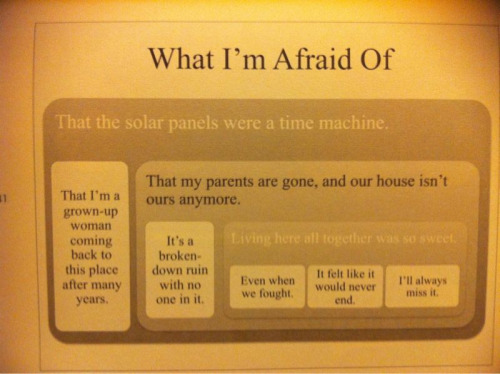
The "What I'm Afraid Of" slide came after she had gone on the kind of long walk with her dad where the world seems incredibly far away.  This is what she is thinking as she walks back to their house.

page 299

My heart hurt in a way I can't describe when I read this.  I remember having moments like this when I was little, but not having a way to express it: feeling, as a child that I would long for the moment I was standing in later as an adult, and feeling despair for the fact that it was impossible to hold on to it.  Alison's voice as a character is different from the rest of the characters, possibly because she is youngest of all narrators, and possibly because what she imagines missing is so pure.  The other narrators, when they are older, miss the teenage and young adult years: the freedom and the hope of what it yet to come.  


"Mom's Art" slide is where Alison tries to explain the art that her mom, Sasha (who the reader meets at the beginning of the book as a 30 year old women in therapy for kleptomania):

"She uses found objects, they come from our house and our lives, she glues them onto boards and shellacs them, she says they're precious because they're casual and meaningless, but they tell the whole story if you really look."


This is an interesting fact to learn about Sasha: that she now "steals" objects that have no meaning to most people, but is able to find meaning in them, and that she seems able to create true meaning in her life.  As a reader, writer and sometimes poet, I love small details that feel meaningless to most people, but have a story underneath.  I think it's significant that Egan uses the word shellacs--it sounds a bit like a desperate push to save something, or, an artistic way to create and remember the details that get forgotten among louder, bolder ones.

I've found myself telling others recently that maybe New York has finally gotten to me because I have felt really cynical about a lot of things lately.  This is not how I would ordinarily describe myself, so it has been interesting to find this creeping in on my psyche and seeing it play out in my life.  Reading this section reminded me that I am both nostalgic and sentimental; and rather than seeing those characteristics as sappy or weak, I think that they allow me to look at the big picture of beauty in life--and that is just what this part-time, temporary cynic needs.

Saturday, January 21, 2012

in the company of those who struggle.


I came across Mary Karr's book Lit after I read an article in New York Magazine about her, David Foster Wallace, Jeffrey Eugenides, and Jonathan Franzen.  I had read all of the authors except for her and sought out to get a copy of The Liars Club.  Then I found Lit, an incredibly written memoir based in Karr's alcohol abuse, the dissolution of her marriage and recovery, on a brownstone's stoop and decided that would work.   I later found out that a few friends of mine had recently read and loved it, so I moved it to the top of my "to read" stack.

{I've learned that sometimes I love to share the story of how I stumbled upon a story.  Thanks for indulging me.}

There are a few parts from Lit that I haven't stopped thinking about. One was that her recovery and redemption came in the company of those who struggled, too.  Karr found herself in AA with a mix of every kind of person imaginable, none of whom she would have sought out on her own.  The friends she made there were from across the social spectrum, people whose paths would have never crossed otherwise. And yet, they became a lifeline for one another because they deeply understood that struggle is best endured together. No one lives immune to hurt--and that means that each of us has something in common with every person we meet.  

I would not normally call myself a cynic, but in the winter it happens from time to time. For some reason that was the space my mind was inhabiting in the week I was reading this book: not in response to the book, but just in response to life.  I often get frustrated at the instagram-portrayed life.  Don't get me wrong, I think small moments of life's poetry are worth sharing, but sometimes it is easy to start thinking that everyone around has a perfectly curated life.  I know this theory is false.  Or, I start soaking in cynicism about the self promotion social media induces.   I've found that when I remember that I am always in (and a part of) the company of those who struggle, my heart seems to grow in compassion.  

I am always trying to teach my students that books make us better people because we learn to empathize with almost any character once we understand the ins and outs of his or her story.  Sometimes the teacher needs to remember this, too. 

 I also didn't realize just how much spirituality was a part of Karr's journey, and when added to a life rich in real community, a portrait of how beautiful--and simple--life can be rose before me. 

"Therapy rescued me in my twenties by taking me inward, leaching off pockets of poison in my head left over from the past.  But the spiritual lens--even just the nightly gratitude list and going over each day's actions--is starting to rewrite the story of my life in the present, and I begin to feel like somebody snatched out of the fire, salvaged, saved," (304).

I really can't add much to her words, except that by allowing herself to consider, and ultimately accept, the way faith, not religious duty, could change a life, her life and mental landscape began to change.  Sometimes I forget this--and reading Karr's story became one of the brightest reminders of my winter--and my own cold weather induced cynicism and anger has begun to slip away.  

truth.

I'm fractured
In the fall
and I want to go home

from Two by Ryan Adams

The kind of literary spirit I love.

"Such a small, pure object a poem could be, made of nothing but air, a tiny string of letters, maybe small enough to fit in the palm of your hand.  But it could blow someone's head off," (59).
from Lit by Mary Karr

Sunday, January 8, 2012

This year's winter.


First,  I have been in discussion with one of my best friends who also happens to be a teacher about how we always think of the "new year" starting in September. We realized that the main way we identify ourselves is through our job, which in many ways is great: teaching English combines so many of my passions.  It is generally hard for me to do a year reflection, because since I've never left the school calendar since infancy, January to me is the end of the first semester...the half way point.  It feels strange to think about 2011 because I had two different groups of students.  I had two different curriculum plans.  But. This is only if I look at my life solely through my profession.


Second, I caught myself spreading my winter blues this morning.  I've written before about my how my college roommate and I diagnosed me with Seasonal Affective Disorder online in 2001 and about how spring-forward is my favorite day of the year.  I've probably even written about how I blame the school calendars of my youth who had flowers decorating the month of March (obviously made by a southerner) for the way my heart starts to get prematurely hopeful for warmer weather.  However, my personal-not-job-related goal for 2012 (the first fourth of it, anyway) is to have a better attitude about the winter.  There. I said it. Please, if you see me, remind me of this.  

Another dear friend sent me an essay from a book called Let Your Life Speak many winters ago about living through the seasons as a polite way of telling me to get a better attitude.  I return to it every year.  It tells me: "Winter is a demanding season...and yet the rigors are accompanied by gifts: ...times of dormancy and deep rest are essential to all living things...One gift of utter clarity as in winter, one can walk into woods that had been opaque and see the trees clearly...Winter clears the landscape, however brutally, giving us a chance to see ourselves and each other more clearly, to see the very ground of our being."  Another friend of mine moved to San Diego from New York and told me that perfection can breed complacency.  

So, I would like to live thankfully and intentionally this winter.  I realized the other day that I never posted about Patti Smith's memoir Just Kids (which would have definitely made it onto the Top Ten).  I reread my notes inside and what I found has a direct correlation with how I want to live in this cold season: 


"...it was the work in a hall devoted to Picasso...that pierced me the most.  His brutal confidence took my breath away." (11)  "I craved honesty, yet found dishonesty in myself...Picasso didn't crawl in a shell when his beloved Basque country was bombed.  He reacted by creating a masterpiece in Guernica to remind us of the injustices committed against his people. When I had extra money I'd go to the Museum of Modern Art and sit before Guernica, spending long hours considering the fallen horse and the eye of the bulb shining over the sad spoils of war. Then I'd get back to work." (65)

"But secretly I knew I had been transformed, moved by the revelation that human beings could create art, that to be an artist was to see what others could not." (11)

"He [Robert Maplethorpe] contained, even at an early age, a stirring and the desire to stir," (13)

I want to stare winter down.   If it makes me angry, I want to do let that anger inspire writing.  Or to fight against it with dinner parties.  Or crawling out of my hole and stepping outside for a run with my friends and then feel as though I have thoroughly kicked it in the rear.  I want it to inspire me to actually live rather than hunkering down with Netflix instant streaming. I want to sense a stirring and stir.